










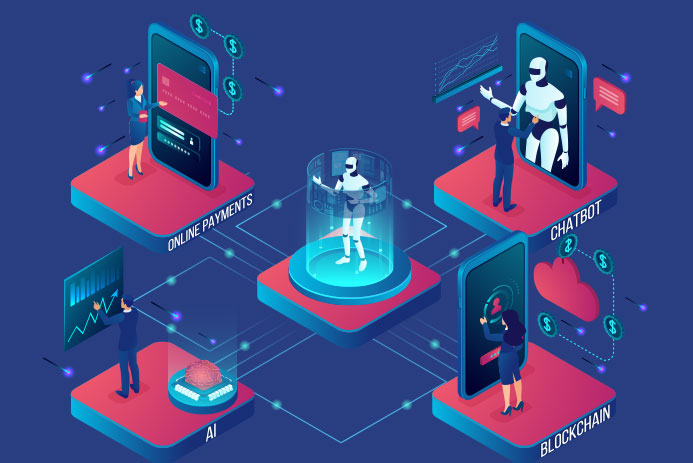
Why AI is a game changer for the banking industry?

The banking industry has always been at the forefront of adopting emerging technologies and has a strong track record for technology-led leadership. This is true in the case of AI too, which has been adopted by many banks in a variety of important functions. Today, this assumes greater significance, as the usage of online and mobile banking channels has risen significantly, and customers have cut down their branch visits in the wake of the pandemic. This has pushed banks to raise their bar for providing digital experiences, as customers expect the same experience that they have been accustomed to from digital upstarts.

With AI, banks can achieve their objectives, as this technology can truly be used to automate their processes (leading to greater efficiencies), engaging with customers and personalising experiences (leading to better customer satisfaction) and risk management. Let us now look at some critical areas in a bank where AI can make a pivotal difference.

Speeding up the process of customer onboarding

AI can make a significant difference in the way banks onboard customers. For example, when a customer wants to open a new bank account or applies for a loan, he or she has to provide a number of documents and identification proofs to the bank. The bank then has to physically scan each document to authenticate the document. This is even more applicable when a customer applies for a loan, and a bank checks bank statements, identification proofs, and other financial details to determine the credit worthiness of the customer. As these are manual activities, they are error-prone and time consuming. Additionally, as there is no real-time verification of information submitted by the customer, there is a possibility of missing or inadequate information.

In an AI-enabled eKYC platform, the entire process can be automated by using AI-driven face match and document verification algorithms. Once the process of eKYC starts, the data from the Government issued ID card and photo can be matched with the live selfie video to authenticate the customer. Data from ID cards is extracted using smart OCR and validated against government supported databases. This helps in completing the KYC in less than one minute compared to a minimum of 2-3 days that is required for customer onboarding.

AI can play a big role in reconciliation too. Today, a significant percentage of reconciliation efforts is spent on analysing transactions that already match, instead of focusing on the entries that require more analysis and investigation. AI can help in completely automating the reconciliation process and reduce the time and efforts that it takes to reconcile transactions. As the process is completely automated, there is no possibility of errors.

Raising the bar for customer experience

AI’s potential in raising the bar for customer experience is the highest in the banking industry. The most basic usage of the power of AI can be seen from the way banks have used chatbots to answer customer queries, besides customer acquisition and engagement. A study by Juniper Research in 2019 estimated that the operational cost savings from using chatbots in banking will reach $7.3 billion globally by 2023. While chatbots are now used by almost every bank, a bigger potential for AI lies in personalising experiences for customers. Considering the huge amount of data that banks have at their disposal (demographic data, transaction data, credit card spends, e-commerce transactions), banks are extremely well placed to hyper-personalise the experience for a customer.

The Boston Consulting Group estimates that a bank can garner as much as $300 million in revenue growth for every $100 billion that it has in assets, by personalising its customer interactions. For example, if a customer is paying rent of Rs 20,000 every month, then the AI model could recommend a home loan to you and show you how the EMI for the house could be a lot lesser than the rent you are paying every month. Similar recommendations can be made by the AI engine when a person crosses a certain age-threshold and suggestions can accordingly be made (health insurance, education loan, etc). AI can also understand and suggest the preferred channel that a specific customer prefers to interact with the bank – some are comfortable with email, some with telephonic calls or some could prefer to interact via chat only.

Preventing fraud

Despite huge technological advances, frauds are a common occurrence, and have only grown in scale. AI’s ability to learn and analyse each banking transaction can be used to prevent frauds. For example, if your credit card has never ever been used abroad, and if a transaction takes place on your card, then the AI system can flag this off, and automatically place a call to you to verify the transaction. If an account is being logged in at an hour that has never ever been recorded in the transaction history of an individual, then the AI system can flag this transaction to the bank.

Banks are also leveraging AI and ML for monitoring purposes. For instance, AI/ML engines are being used analyse data and then breaking them down to detect any malicious activity or presence of any compromising malware. Apart from security prioritization, AI also helps in assessing phishing websites, malicious attempts, and all other vulnerabilities.

Similarly, AI can be a big powerful asset in leading the fight against anti-money laundering. An AI powered anti-money laundering solution can monitor for example, small innocuous irregular deposits that are then transferred to a global merchant. By shifting through mountains of data and connected entities, the AI system can identify patterns that signify money laundering and provide a bank with insights into previously unknown relationships.

How can AI enable Banking-as-a-Service?

For AI to run efficiently, it needs huge amount of computational power. While HPC systems are well equipped to power AI-driven transactions, the cost is prohibitive. This is where HPC as a service can be utilized for accessing AI as a service.

This gives cost efficiencies with guaranteed performance. This requires zero CAPEX investment and can be consumed using a pay-as-you-use model. Scalability is also not an issue and can be scaled up or down as per the workloads.

Democratisation of AI is not possible today as AI is not accessible by all and is considered too costly to implement. This can be made possible by adopting Banking-as-a-Service, which is enabled by AI. All banking related services can be consumed as a service. Small banks or financial institutions that do not have access to AI powered solutions can use Banking-as-a-Service, as all these solutions are available on a pay-per-use model. Currently, the usage of AI in banking is low, primarily because of infrastructure-related costs. This is where High Performance Computing-as-a-Service can be a big catalyst for democratising the usage of AI.

Today, a bank’s competition may not strictly be a bank, and can be a pure play technology company. Technology companies who have a deeper understanding of technology and work on huge data sets are better placed to provide a better customer experience. Samsung, Google and Apple are some of the best examples that showcase this capability. The popularity of Google Pay shows how relatively new entrants with deep technology expertise can disrupt the payments space. Banks have also understood the significance of these disruptive technologies and are actively partnering or investing in startups who specialise in emerging technologies. A case in point is ICICI Bank, which has taken a stake in Tapits Technologies, a startup that enables contactless merchant onboarding using eKYC.

In the future, as more banks embrace a more digital future, it will be imperative for all banks to have an AI-first approach. Even the government has time and again emphasised that for banks to transform and fulfill India’s growing needs, they mist harness technologies like AI and Big Data. As more digital only banks enter the fray, this approach will be critical in defining their future competitiveness!

The future of enterprise IT: What the next decade holds for us

During the beginning of the year 2020, the Synergy Group had come out with a detailed review of enterprise IT spending over the last ten years. The analysis revealed that annual spending on cloud infrastructure services had gone up from virtually zero to almost $100 billion. In a recent report in December, the Synergy Group revealed that enterprise spending on cloud infrastructure services (IaaS, PaaS, and hosted private cloud services) and SaaS reached $65 billion in the third quarter, up 28% from the third quarter of 2019. Undoubtedly, COVID-19 drove changes in enterprise behavior and sped up the transition from on-premise operations to cloud-based services. These statistics reveal the unstoppable march of cloud computing as a technology and points out to the fact that the COVID-19 pandemic has only accelerated adoption by a significant percentage.

Today, even as the world waits for the vaccine to be available for the common masses, almost everything has been reset. IT infrastructure and procurement will never be the same again and will have a big impact on the next decade.

From my experience, I would like to point out key trends that I believe would be extremely important for enterprise IT in the next ten years:

1 Every company will use the cloud

The cloud’s growth has been unstoppable, as can be seen from the predictions of independent analysts. The industry estimates further suggests that cloud will be an irreplaceable component of enterprise IT in the future. Even today, the growth of almost every emerging technology depends heavily on the cloud, and is the foundational platform for AI, IoT and Analytics. While each technology can function on-premise too, it is the cloud that gives these technologies the firepower, and this is set to become more prominent in the future. Enterprise IT will be associated with cloud, and every company will use the cloud in one form or the other.

2 The edge will move to the center

It is a connected world, and the future will see an explosion of devices being connected to the Internet. A McKinsey study for example, claims that 127 new IoT devices connect to the Internet every second. Data centers will have to be built keeping this trend in mind, as organisations will look at keeping data close to the location where it is being generated. Also called as edge computing, this requires placing data center nodes as close to the sources of data and content. As more devices such as autonomous cars require real-time access and decision-making capability, it will not be feasible to transmit data all the way to a traditional cloud. With 5G on the horizon, edge computing will remain in high demand, as it ensures low latency and high speed. This is corroborated by the IDC FutureScape report, which states that by 2022, 40% of enterprises will have doubled their IT asset spending in edge locations.

3 An era of joint cloud offerings

The next decade will be defined by multi-cloud offerings, and every customer will look at having different cloud vendors for specific workloads. In 2019, the industry witnessed a landmark alliance between Oracle and Microsoft. This enables customers to migrate or run their enterprise workloads across Microsoft Azure and Oracle Cloud. Customers can have the best of both worlds, by running one part of a workload within Azure and another part of the same workload within the Oracle Cloud. This agreement heralds the arrival of an era where customers will have the ability to run applications that share data across clouds. In the future, we will see more partnerships between fierce rivals.

4 Domain specific clouds will become the norm

Like other industry software such as ERP, cloud will also highly become domain specific. An example of this trend can be seen from the recent launch of the Microsoft Cloud for Healthcare, which is designed to enhance patient engagement, empower team collaboration, and improve clinical and operational data insights to connect data from across systems to predict risk and help improve patient care and operational efficiencies. This industry-specific solution provides integrated capabilities for automated and efficient high-value workflows, and advanced data analysis functionally for structured and unstructured data so that healthcare organisations can truly transform information into insight and insight into action. Going forward, we will see the creation of highly specialised cloud, as specific industries require specialised functionalities. This is also needed in the case of regulated industries such as financial services and telecom, where companies need to comply with specific regulations as required by the authorities.

5 Rise in As-a-Service models

With cloud adoption increasing, there will be a rise in affordable ‘As-a-Service’ models for specific industries. Today, thanks to the cloud, almost every service can be offered in a virtual way. Enterprises will combine intelligent analytics with products, leading to an era of productised services. In the future, almost every machine will have the option of being serviced remotely. Availability of cheap bandwidth coupled with a rise in intelligent devices, will lead to enterprises providing data insights for their devices.

We will also see a rise in industry focused ‘As-a-Service’ models. With no limits of computational power, we will see new industry focused models emerging. For example, small banks or financial firms that do not have the financial ability to invest in emerging technologies such as AI can make use of ‘Banking-as-a-Service’ and consume services in a pay per use model. Similarly, pharmaceutical firms can make use of a service such as ‘Drug discovery-as-a-Service’ to use the technological capabilities of firms to significantly reduce the time for discovering a drug. Similarly, the manufacturing sector can use ‘Manufacturing-as-a-Service’ to reduce their costs for manufacturing. A company called 3D Hubs, for example, has built a common hub for manufacturers to share 3D printers that do not want to invest on their own. In the next few years, the adoption of ‘As-a-Service’ models will be witnessed in every sector.

6 Democratisation of AI

While AI holds huge promise for transforming every possible industry, it is limited by the huge computational power that is required to power AI systems. In 2018, OpenAI, an AI research and development firm, highlighted that that the amount of computational power required to train the largest AI models has doubled every 3.4 months since 2012. Looking at the increased demand for computational power for AI, researchers at the Massachusetts Institute of Technology, recently warned that deep learning is hitting computational limits. However, with more cloud power being available, AI will become truly mainstream. Today, thanks to the cloud, there are no limits. As AI needs more data to learn, a cloud-model can help in ingesting more data, leading to more learning. A cloud-model is also more economical, as it allows enterprises to purchase only the specific computational power they need, even if it is for a short duration.

7 Energy efficiency will be the new benchmark

In the future, energy efficiency will be a competitive benchmark for data center providers. Research firm, Gartner, estimates that power costs will increase at least 10% per year due to cost per kilowatt-hour (kwh) increases and underlying demand. Close to 70% of a hyperscale colocation data center operational expenditure is power, and as demand increases, this number is only set to rise further. From innovative cooling mechanisms to using natural gas, solar or wind energy extensively, the future will see a rise in energy related innovations, as energy efficiency becomes the new benchmark.

8 India will become the global hub for data centers

India already has a huge number of factors that will help it to position itself as a global hub for data centers. This can also be seen from the huge number of investments that this sector has received. A recent report by property consulting firm Anarock, states that India’s data centers received $977 million in private equity and strategic investments since 2008, of which nearly 40% or approximately $396 million were infused between the January-September 2020 period. The report further states that India will see an addition of at least 28 large hyperscale data centers over the next three years. The reasons are clear – India already is well known across the world as a software services powerhouse. It is also home to a large developer population. The Progressive Policy Institute (PPI), India expects the country to overtake the US as world’s largest developer population center by 2024. Data consumption is increasingly rapidly. A fast-rising e-commerce and increasing consumption for OTT services is also fueling the demand for data. When one looks at the current demand, and what it will lead to, you can visualise the huge growth that is going to come for data centers.

How businesses will benefit?

Each of the above trends points out to an era that will increasingly use data insights for improving their own efficiencies and productivity levels. For example, democratisation of AI will level the playing field between large and small players. Companies can use the ‘As-a-Service’ model to reduce the entry barriers and start experimenting with emerging technologies using the foundation of cloud. Financial or technological capability will no longer be the roadblock, and domain experts in sectors such as healthcare or manufacturing can use the potential of AI to solve some of the biggest problems concerning their industries. Simply put, there are no restrictions, and any company or individual can start experimenting with negligible costs.

Data centers have to think beyond ‘infrastructure’

Data center players will also have to be nimble and think innovatively to start offering services and solutions that are beyond the usual IaaS or PaaS offerings. For example, can data center players offer ‘High Performance Computing-as-a-Service’ to say, a small pharmaceutical company? Can data center service providers create unique co-created solutions by taking in active inputs from the community and solving known problems at a price point that they can afford? Can data center players create their own IP that helps their clients improve their energy efficiencies by a significant margin?

The future will belong to those data center companies who can provide answers to such questions or solve the challenges faced by the industry; and service providers that can scale quickly without any limits and provide intelligent outcome-based models that help their clients achieve the business objectives through a portfolio of ‘As-a-Service’ models.

The Future of Enterprise IT

Source: https://www.techcircle.in/2021/01/25/the-future-of-enterprise-it-what-the-next-decade-holds-for-us