











Oracle KVM vs. VMware: In-Depth Feature Analysis and Market Growth Insights

Virtualisation is a cornerstone of modern IT infrastructure, enabling businesses to optimise resources, scale efficiently, and reduce costs. Although VMware is a major player in this space, Oracle KVM is fast catching up. This blog post compares their features, costs, market growth, and prospects, and explores why Oracle KVM may be particularly advantageous for Oracle database customers.

Feature Comparison

FeatureOracle KVMVMware
Hypervisor TypeXen-basedESXi (bare-metal)
Management ToolsOracle Linux Virtualization ManagervCenter Server
Supported Guest OSBroad range including Oracle Linux, Windows, SolarisWide range including Linux, Windows, Solaris
IntegrationTight integration with Oracle services and productsExtensive third-party integrations
High AvailabilityYesYes
Live MigrationYesYes (vMotion)
Storage ManagementOracle VM Storage ConnectvSAN, VMFS, NFS
NetworkingOracle VM Virtual NetworkingNSX
Hard PartitioningYesNo
Backup and RecoveryOracle Recovery Manager (RMAN)vSphere Data Protection, third-party tools
LicensingIncluded with Oracle productsSeparate licensing

Cost Comparison

AspectOracle KVMVMware
License CostIncluded with Oracle productsVaries; Higher costs, especially for vSphere Enterprise Plus
Support CostGenerally Lower, included with Oracle support contractsHigher Support costs, depending on service level
Initial Cost SetupLower, due to inclusion with OracleHigher, due to separate licensing
Total Cost of Ownership (TCO)Lower for Oracle-Heavy environmentsHigher especially with additional features

Growth Trajectory and Market Dynamics

Oracle KVM:

  • Market Growth: Oracle KVM has experienced steady growth, particularly in enterprises heavily utilising Oracle databases and applications. Its seamless integration with Oracle products makes it a compelling choice for such environments.
  • Future Prospects: The future of Oracle KVM is promising, with ongoing enhancements to support the new Oracle database and application features, aligning with Oracle’s cloud strategy.

VMware:

  • Market Growth: VMware remains a dominant player in the virtualisation market, known for its extensive feature set and robust ecosystem. It is preferred for large-scale and heterogeneous environments.
  • Future Prospects: VMware’s future is strong, driven by innovation in hybrid cloud, edge computing, and Kubernetes integration (via Tanzu).
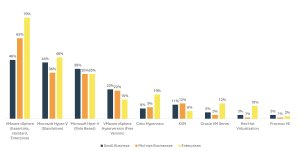
Oracle-KVM-vs-VMware-Feature-Comparison-chart

[Src: Spiceworks survey]

Why Choose Oracle KVM?

  • Tight Integration with Oracle Products: Oracle KVM provides optimised performance and easier management for Oracle-heavy environments due to its seamless integration with Oracle databases and applications.
  • Cost Efficiency: Inclusion with Oracle products mean lower licensing and support costs, resulting in a reduced total cost of ownership (TCO) for organizations invested in Oracle solutions.
  • Hard Partitioning: Oracle KVM supports hard partitioning, essential for Oracle database customers to comply with licensing policies. This feature allows precise allocation of CPU resources, potentially reducing licensing costs and improving performance.
  • Simplified Management: Oracle KVM Manager offers an intuitive interface for managing virtual environments, simplifying administrative tasks and reducing operational overhead.
  • Robust Security and Compliance: Oracle KVM aligns with Oracle’s security standards, ensuring enterprise data remains secure and compliant with industry regulations.

Hard Partitioning: A Key Benefit for Oracle Database Customers

Hard partitioning in Oracle KVM enables administrators to allocate specific CPU cores to virtual machines, which is beneficial for Oracle database customers because it:

  • Optimises Licensing Costs: Limits the number of CPU cores allocated to Oracle databases, helping to manage and potentially reduce licensing costs.
  • Improves Performance: Dedicated resources ensure consistent performance for critical Oracle database workloads, reducing the risk of resource contention.
  • Enhances Compliance: Helps organisations comply with Oracle’s licensing policies, avoiding potential legal and financial issues.

Conclusion

Both Oracle KVM and VMware offer robust virtualisation solutions, each with distinct advantages. Oracle KVM is particularly suited for enterprises reliant on Oracle databases and applications, providing cost efficiency, tight integration, and the benefit of hard partitioning. VMware remains a versatile choice for diverse and large-scale environments, with a comprehensive feature set and a strong market presence. Organisations should consider their specific needs, existing investments, and future growth plans when choosing between Oracle KVM and VMware. For Oracle-centric environments, Oracle KVM offers compelling benefits that align well with Oracle’s broader ecosystem and strategic direction.

Yotta’s suite of Oracle solutions empowers businesses to streamline operations and achieve transformative outcomes by eliminating complexities. With all Oracle services— from software and licenses to infrastructure—delivered under one roof, Yotta simplifies deployment and management, backed by dedicated technical support and robust infrastructure. The flexible, pay-as-you-go model ensures transparent pricing, while Yotta’s Oracle Service Portfolio covers everything from consulting and migration to database implementation and managed services, maximizing success across business functions.

Choosing the Right Oracle Database Edition for Financial Institutions: Standard vs. Enterprise

Selecting the right database solution is crucial for financial institutions, where data integrity, security, and performance are paramount. Oracle offers two major editions of its database software: Oracle Database Standard Edition and Oracle Database Enterprise Edition. In this blog, we will explore these editions in the context of RBI (Reserve Bank of India) policy and explain why Oracle Database Enterprise Edition is the recommended solution for financial institutions of all sizes.

Understanding Oracle Database Editions

Oracle Database Standard Edition is designed for labs, education and smaller to medium-sized businesses. It provides core database functionalities, offering a cost-effective solution for general database needs.

Oracle Database Enterprise Edition is tailored for large-scale enterprises and organizations with more demanding database requirements. It includes advanced features that enhance performance, security, scalability, and manageability.

RBI Policy and Financial Data Management

 The Reserve Bank of India (RBI) mandates strict compliance and data management standards for financial institutions. Key RBI guidelines include:

  • Data Security and Privacy: Ensuring customer data is protected against unauthorised access and breaches.
  • Compliance and Reporting: Maintaining accurate records and timely reporting to regulatory bodies.
  • Disaster Recovery: Implementing robust disaster recovery plans to ensure business continuity.

Following are the RBI Security guidelines:

  • Guidelines on Information security, Electronic banking, Technology risk management and cyber frauds (2011)
  • Cyber Security Framework in Banks (2016)
  • Basic Cyber Security Controls for Primary (Urban) Cooperative Banks (UCBs) (2018)
  • Comprehensive Cyber Security Framework for Primary (Urban) Cooperative Banks (UCBs) – A Graded Approach (2019)

Why Choose Oracle Database Enterprise Edition?

1. Advanced Security Features:

Oracle Database Enterprise Edition offers superior security mechanisms such as Transparent Data Encryption (TDE), Data Redaction, and Advanced Security options. These features are essential for complying with RBI’s stringent data security guidelines. For online Oracle database deployments, the Enterprise Edition’s advanced security capabilities ensure that sensitive financial data remains protected.

2. High Availability and Disaster Recovery:

Enterprise Edition includes Oracle Data Guard and Real Application Clusters (RAC), ensuring high availability and robust disaster recovery capabilities. These features are crucial for financial institutions that cannot afford downtime. Leveraging these capabilities through Oracle Cloud solutions further enhances reliability and resilience.

3. Performance Optimization:

With features like In-Memory Database, Partitioning, and Advanced Compression, Enterprise Edition significantly enhances performance, making it suitable for high-transaction environments typical of financial institutions. Oracle services in the Enterprise Edition ensure that performance is optimized for demanding financial applications.

4. Scalability:

Enterprise Edition can scale to meet the growing needs of a financial institution, handling large volumes of transactions and data efficiently. As financial institutions expand, the scalability offered by Oracle Cloud solutions supports future growth seamlessly.

5. Compliance and Auditing:

Comprehensive auditing capabilities and compliance features help financial institutions meet regulatory requirements effortlessly. Features like Audit Vault & Database Firewall (DAM solution) ensure that compliance and auditing are managed effectively.

Comparison Table: Oracle Standard Edition vs. Enterprise Edition

FeatureStandard EditionEnterprise Edition
Basic Database FunctionsYesYes
Advanced SecurityLimitedFull Suite (TDE, Data Redaction, etc.), DAM, Oracle Data Masking and Subsetting Pack, DB Vault
High AvailabilityBasic Failover SupportOracle Data Guard, RAC
Performance FeaturesBasic PerformanceIn-Memory Database, Partitioning, etc.
ScalabilityLimitedHigh scalability for large environments
Backup and RecoveryBasicAdvanced (RMAN, Flashback, etc.)
ManageabilityBasic toolsAdvanced management and automation tools
Compliance and AuditingBasic auditingComprehensive auditing and compliance (Audit Vault & Database Firewall – DAM solution)
CostEconomicalPremium, advanced features

Conclusion

For financial institutions, including small finance banks, cooperative banks, and mid to large-sized banks, Oracle Database Enterprise Edition is the recommended choice. Its advanced security features, high availability, performance optimization, scalability, and comprehensive compliance capabilities make it a superior option compared to the Standard Edition. While the Standard Edition provides essential functionalities at a lower cost, it lacks the advanced features necessary to meet the stringent requirements of the financial sector as mandated by RBI guidelines. By choosing Oracle Database Enterprise Edition, institutions can ensure reliable, secure, and efficient operations, while benefiting from the robust offerings of Oracle Cloud solutions and online Oracle database services.

Yotta’s Oracle Service Portfolio offers expert consulting to analyse and tailor Oracle solutions for diverse business needs. Yotta provides seamless upgrade, migration, and database implementation services, along with comprehensive IT infrastructure management for public, private, and hybrid cloud environments. Additionally, Yotta delivers high-quality managed services and Oracle Cloud Infrastructure solutions to enhance scalability, security, and agility for modern workloads.