










Unified Cloud and Networking Management: Streamlining Operations Across Multiple Cloud Platforms and on-premises Environments

Businesses are increasingly adopting multi-cloud strategies to leverage the strengths of different cloud providers and enhance operational flexibility. Unified cloud and networking management is becoming a critical capability for organisations to streamline operations across multiple cloud platforms and on-premises environments.

Connectivity is key to achieving this, but establishing multiple connections to different cloud platforms results in high costs, complex management, and a lack of visibility and control. Imagine a solution that bridges the gap between your infrastructure and cloud platforms, while eliminating the hassles of complex connections and high costs. Unified cloud management is becoming a critical capability for organisations to streamline operations across multiple cloud platforms and on-premises environments.

Unified cloud management involves integrating and overseeing various cloud services—public, private, and hybrid—alongside on-premises systems through a single management interface. This approach helps organisations simplify operations, enhance visibility, and boost efficiency by providing a clear view and control over all IT resources. By consolidating management tasks, organisations can reduce complexity, streamline workflows, and ensure consistent policies across their different environments.

  1. Flexibility and Avoidance of Vendor Lock-In: One of the key benefits of multi-cloud solutions is the flexibility to choose the best cloud services for specific needs. By avoiding vendor lock-in, organisations can select different cloud providers based on their strengths—such as superior machine learning capabilities, robust security features, or cost-effective storage solutions. This flexibility enables businesses to optimise their cloud strategy and adapt to changing requirements.
  2. Enhanced Risk Management: Relying on a single cloud provider can expose organisations to risks such as service outages or data breaches. Multi-cloud strategies mitigate these risks by distributing workloads across multiple providers. This diversification reduces the impact of a single point of failure and enhances overall system resilience.
  3. Access to Best-of-Breed Services: Different cloud providers offer specialised services that may be superior in specific areas. For instance, one provider might excel in data analytics, while another is known for its cutting-edge AI tools. Multi-cloud computing allows organisations to leverage the strengths of various providers, ensuring they have access to the most advanced and suitable services for their needs.

Understanding Yotta’s Unified Cloud Management:

Yotta’s Unified cloud management platform along with Global Cloud Konnect solution, integrated with DE-CIX DirectCLOUD, facilitates easy connectivity between  major global cloud providers such as Microsoft Azure, AWS, Google Cloud,  Oracle Cloud, Office 365. Seamless connectivity across different cloud platforms ensures smooth data flow, reduces transfer costs, and minimises latency, enabling businesses to optimise their multi-cloud strategy without being hindered by network complexity or performance issues.

Features of Yotta Global Cloud Konnect

  • Direct Connectivity for Colocated Clients: Businesses colocated at Yotta can establish direct connectivity using Cross Connect to connect their infrastructure to DE-CIX nodes. This setup provides straightforward access to a variety of cloud services via Global Cloud Konnect.
  • Convenient Access from Various Connectivity Locations: Organisations with on-premises infrastructure can also take advantage of Global Cloud Konnect by linking their systems to the closest Yotta connectivity site, ensuring smooth integration and enhanced connectivity options.
  1. Simplified Operations: Managing multiple cloud platforms and on-premises systems individually can lead to increased complexity and operational overhead. Unified cloud management simplifies these operations by providing a single pane of glass for monitoring, controlling, and managing IT resources. This centralisation reduces the need for disparate management tools and interfaces, streamlining administrative tasks and minimising the risk of errors. For example, instead of navigating through various cloud provider dashboards and on-premises management systems, IT teams can access a unified platform that integrates all their resources. This streamlined approach allows for more efficient task execution, from provisioning and configuring resources to monitoring performance and managing incidents.
  2. Enhanced Visibility and Control: One of the primary advantages of unified cloud management is the enhanced visibility it provides into the entire IT landscape. By consolidating data from multiple cloud platforms and on-premises systems, organisations gain a comprehensive view of their infrastructure. This visibility enables better decision-making and more effective management of resources. It typically includes dashboards and reporting tools that aggregate data from various sources. IT teams can monitor key performance indicators (KPIs), track resource utilisation, and analyses trends across their entire environment. This holistic view facilitates proactive management, allowing teams to identify and address potential issues before they impact operations.
  3. Consistent Policy Enforcement: In a multi-cloud and hybrid environment, ensuring consistent policy enforcement can be challenging. It helps address this issue by providing tools to implement and enforce policies across all environments. Organisations can define security protocols, compliance requirements, and operational standards centrally, ensuring that all resources adhere to the same guidelines. For instance, security policies such as access controls, encryption standards, and vulnerability management can be applied uniformly across cloud and on-premises resources. This consistency helps reduce the risk of security breaches and compliance violations, ensuring that the organisation’s IT environment remains secure and compliant.
  4. Cost Optimisation: With resources spread across multiple cloud providers and on-premises systems, tracking and optimising expenditures can be complex. Unified management tools provide insights into resource usage and spending patterns, helping organisations identify opportunities for cost savings. By analysing data from various sources, IT teams can optimise resource allocation, eliminate waste, and negotiate better pricing with cloud providers. Additionally, unified management solutions often include budgeting and forecasting features, allowing organisations to plan and manage their IT budgets more effectively.
  5. Improved Security and Compliance: Security and compliance are top priorities for organisations operating in multi-cloud and hybrid environments. Unified cloud management enhances security by providing centralised control over access, monitoring, and threat detection. This approach ensures that security measures are consistently applied across all resources, reducing vulnerabilities, and improving overall protection. Unified management platforms often include advanced security features such as real-time threat monitoring, automated incident response, and compliance reporting. These tools help organisations detect and respond to security incidents more quickly, ensuring that their IT environment remains secure and compliant with relevant regulations.
  6. Seamless Integration and Interoperability: A key challenge in multi-cloud and hybrid environments is ensuring that different systems and platforms work together seamlessly. Unified cloud management solutions facilitate integration and interoperability by providing connectors and APIs that bridge disparate systems. For example, a unified management platform can integrate with various cloud providers’ APIs, allowing for smooth data transfer and application interoperability. This integration simplifies workflows, enables more efficient resource management, and enhances the overall user experience.

Conclusion:

To optimise performance in a multi-cloud environment, seamless integration of your infrastructure and cloud services is important. Yotta Global Cloud Konnect simplifies this by providing a reliable connection to leading global cloud providers, ensuring your data takes the fastest route and reducing latency. This solution also eases the workload on your IT teams by consolidating connections, streamlining operations, and enhancing service delivery to customers-all while lowering costs.


How Yotta Power Cloud Revolutionises Hybrid Cloud Computing

The demand for robust, flexible, and secure IT infrastructures has never been higher. Traditional data centers and legacy systems are increasingly being replaced by cloud solutions that offer scalability, cost-efficiency, and enhanced performance. Yotta Power Cloud, a cutting-edge platform built in collaboration with IBM Power, is designed to revolutionise the way enterprises manage their critical workloads and emerging technologies.

Yotta Power Cloud elevates hybrid cloud computing by unifying private cloud and on-premises infrastructure with a seamless public cloud environment. This combination creates a flexible and powerful IT ecosystem capable of meeting the growing demands of modern businesses.

The Power of IBM Power in Yotta Power Cloud

One of the key reasons Yotta Power Cloud stands out is its collaboration with IBM Power. IBM has long been recognised as a leader in the enterprise IT space, known for its innovative and reliable solutions. The IBM Power Systems—specifically the IBM P-Series—are trusted by businesses around the globe for their unmatched performance, reliability, and security. Yotta Power Cloud delivers a robust, enterprise-ready cloud infrastructure designed to handle both today’s and tomorrow’s workloads.

Here are some of the core benefits that Yotta Power Cloud provides:

  • Unmatched Reliability and Uptime: IBM Power is built to provide industry-leading server reliability and uptime. According to IBM, 93% of IBM Power customers report up to 6x better system reliability and availability. For enterprises that rely on mission-critical applications, this level of reliability is a game-changer. Downtime is costly, and with Yotta’s proven infrastructure, businesses can ensure their operations remain seamless and uninterrupted, even during high-demand periods.
  • Enterprise-Ready Cloud Integration: IBM Power easily integrates with private or hybrid cloud environments, making it an ideal choice for businesses seeking to build or migrate their workloads to the cloud. Whether you are looking to extend your on-premise infrastructure to the cloud or fully transition to a hybrid cloud model, Yotta Power Cloud offers a flexible and customizable solution that adapts to your specific needs. This integration ensures a smooth and efficient transition with minimal disruption to business operations.
  • Cutting-Edge Technology: Yotta Power Cloud leverages the most advanced processor technologies available today. Powered by IBM Power’s state-of-the-art I/O subsystem technology, including next-gen NVIDIA NVLink, PCIe Gen4, and OpenCAPI, this cloud platform is built for high-performance computing. These technologies allow for faster data processing, more efficient workload management, and seamless scaling, making it an ideal solution for businesses looking to harness the full potential of AI, machine learning, and other data-intensive applications.
  • Proactive Security and Threat Detection: In an age where cybersecurity threats are increasingly sophisticated, businesses need infrastructure that can not only detect attacks but also respond quickly. Yotta Power Cloud provides enhanced security features that protect your enterprise from breaches. One standout feature is its ability to detect and thwart attacks immediately or within just 10 minutes of a breach. This proactive approach gives businesses a much larger response window to mitigate potential damage, protecting both sensitive data and business continuity.

Supporting Emerging Technologies

As businesses increasingly turn to technologies like AI, machine learning, and big data analytics to stay competitive, they need a cloud infrastructure that can keep pace. Yotta Power Cloud is designed to support these emerging technologies by providing the high-performance computing power, advanced storage, and security needed to handle massive data volumes and complex workloads.

The platform’s ability to seamlessly integrate with AI and ML frameworks ensures that businesses can easily deploy, scale, and manage their AI models in the cloud. Whether you are training deep learning models or running big data analytics, Yotta Power Cloud provides the resources and flexibility needed to accelerate innovation and unlock valuable insights from your data.

Conclusion

The future of cloud computing is hybrid, and Yotta Power Cloud is at the forefront of this revolution. By combining the best of IBM Power’s cutting-edge technology with the flexibility and scalability of hybrid cloud computing, Yotta Power Cloud offers a solution that is not only powerful but also future-proof. With unparalleled reliability, proactive security, and support for emerging technologies, Yotta Power Cloud is the perfect platform for businesses looking to take advantage of the latest IBM p-series machines, without the hefty CapEx associated with it,

For enterprises that want to embrace the future of cloud computing, Yotta Power Cloud offers a flexible, cost-efficient, and secure solution that will accelerate their digital transformation journey.

A Comprehensive Guide to Oracle Database Migration: Advisory, Planning, Execution, and Support 

Migrating an Oracle Database is a significant process for organisations aiming to modernize infrastructure, improve performance, or transition to the cloud. Whether you’re upgrading versions or switching platforms, a structured approach is crucial for success. Successful migrations are not only about moving data but also about ensuring continuity, scalability, and optimal performance post-migration. A comprehensive approach enables organisations to take advantage of new functionalities while minimising disruptions to ongoing operations.  

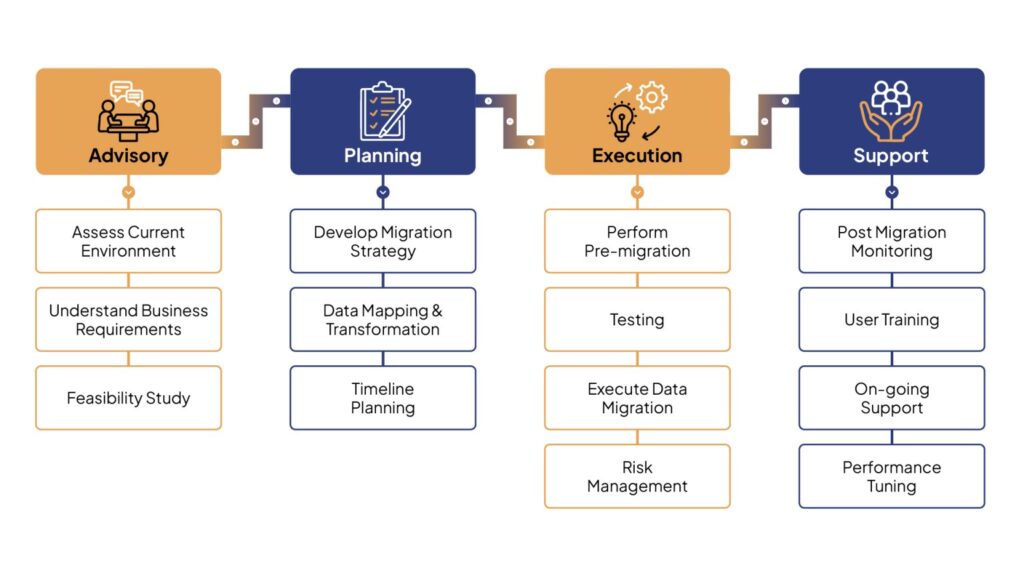
This guide outlines the key phases of Oracle Database migration: Advisory, Planning, Execution, and Support, highlighting important considerations throughout the process. 

  1. Advisory Phase

This phase establishes the foundation for your migration project by assessing the current environment and understanding business requirements. 

  • Current Environment Assessment:  Evaluate the hardware, software, and network configurations of your existing database to understand its current state. This analysis provides a baseline for migration planning and identifies any infrastructure upgrades needed. 
  • Business Requirements:  Define your migration goals, whether they involve cost reduction, performance improvements, or enhanced security features. Clearly outlining these objectives will guide decision-making and ensure alignment with overall business priorities. 
  • Feasibility Study:  Consider the different migration options, such as moving to the cloud or maintaining an on-premises setup, while evaluating each for technical and financial feasibility. Factor in acceptable downtime and budget constraints to select the most practical migration approach for your organisation. 
  1. Planning Phase

In this phase, a detailed roadmap for migration is created to minimize risks and ensure smooth execution. 

  • Migration Strategy:  Develop a strategy that best fits your needs, such as a full database migration or a phased approach to minimize downtime. This tailored strategy will help streamline execution and align resources efficiently throughout the process. 
  • Data Mapping & Transformation:  Plan how data will be transferred, including any transformations or cleansing needed to ensure compatibility with the new environment. This step helps prevent data integrity issues and enables a smooth transition to the target system. 
  • Timeline & Resource Planning:  Set milestones to track progress, and assign team roles to clarify responsibilities. Clear timelines and role definitions keep the project organised and prevent resource bottlenecks. 
  • Risk Management:  Identify potential risks, from data loss to compatibility issues, and establish mitigation strategies, including backup and fallback plans. Proactive risk management minimizes unexpected disruptions and provides a safety net during migration. 
  1. Execution Phase

This is where the actual migration happens, requiring careful coordination and testing. 

  • Pre-Migration Testing:  Conduct comprehensive tests in a staging environment that mirrors the production setup, checking for data integrity and performance issues. This testing phase helps identify potential errors and prepares the team for a successful migration. 
  • Data Migration:  Execute the actual data transfer, using methods such as replication, Oracle Data Pump, or other tools suited to the project’s needs. Ensuring data is transferred accurately and securely is critical to maintaining operational continuity. 
  • Cross-Platform Migration:  Address any platform-specific challenges that arise, such as endian conversion or compatibility adjustments between different operating systems. Managing these technical nuances is essential for ensuring a seamless experience on the target platform. 
  • Post-Migration Testing: Perform extensive validation testing to confirm the success of the migration, checking for data accuracy, system performance, and application compatibility. This step verifies that the new environment meets all operational requirements before going live.  
  1. Support Phase

Post-migration support is vital to maintain database stability and optimize performance. 

  • Monitoring: Use tools like Oracle Enterprise Manager to continuously monitor database performance and system health.  
  • User Training:  Effective training programs can boost adoption rates and help users transition smoothly, reducing the volume of post-migration support tickets.. 
  • Ongoing Support:  Robust ongoing support includes technical assistance to resolve issues promptly, regular performance tuning to maintain optimal efficiency, and scheduled updates to apply security patches and new features. 
  1. Special Considerations for Cross-Platform and Cloud Migrations
  • Platform Compatibility:  Verify that the target platform can support all features of the source platform, including hardware configurations, software dependencies, and specific database functionalities. This step minimises functionality gaps and reduces post-migration adjustments. 
  • Cloud Migrations:  Account for critical cloud-specific factors such as network latency, data security, and regulatory compliance to maintain performance and meet legal standards. Consider data residency requirements and cloud provider certifications to ensure the environment aligns with your organisation’s security policies. 
  • Upgrading to the Latest Version:  Use tools like Oracle’s Database Upgrade Assistant (DBUA) to streamline the upgrade process when migrating to newer Oracle Database versions. These tools help automate compatibility checks and optimise performance on the upgraded system, reducing the risk of manual errors. 

The following diagram illustrates the phases involved in Oracle Database migration: 

  1. Additional Tips for a Successful Migration
  • Communication: Keep stakeholders informed throughout the migration process. 
  • Backup and Recovery: Ensure robust backup and recovery plans. 
  • Performance Tuning: Focus on database optimization post-migration. 

Conclusion 

By following this structured approach, organizations can navigate Oracle Database migrations with confidence. Yotta’s Oracle Solutions & Managed Services offer expertise across each phase, ensuring a smooth transition to the cloud, platform switch, or version upgrade.  To make your Oracle Database migration seamless, Yotta’s Oracle Services provide end-to-end support, from advisory to execution and ongoing management.