Best Practices for Securing Your Hybrid Cloud Environment 

As organisations increasingly adopt hybrid cloud architectures – blending private, public, and on-premise infrastructures – the complexity of securing these environments has grown significantly. Gartner predicts that by 2027, 90% of organisations will embrace hybrid cloud strategies, highlighting the urgent need to scale hybrid infrastructures to support the growing demand for Gen AI deployment.  

While hybrid setups offer unmatched flexibility, scalability, and cost-efficiency, they also create a fragmented infrastructure landscape marked by inconsistent security tools, varying identity management systems, and uneven visibility across platforms. Public cloud services may offer integrated IAM and monitoring, but private data centers often require separate solutions – leading to gaps in enforcement and increased risk of misconfigurations. This broader threat surface is further amplified by the rise of AI-powered attacks and the limitations of siloed security tools. To address these challenges, IT leaders must implement a comprehensive strategy that integrates advanced technologies, zero trust principles, and continuous oversight to meet evolving security and compliance demands. 

Start with a Unified Security Framework 

The foundation of a secure hybrid cloud lies in a consistent security strategy that spans all environments. Security objectives should align closely with broader business goals, supported by comprehensive risk assessments that reflect the interconnected nature of modern infrastructure. Clear governance policies are essential – defining how data is classified, how access is managed, how networks are segmented, and how compliance is maintained across platforms. 

Equally important is the implementation of strong data governance practices. These should specify where different categories of data are stored and how they are protected as they move throughout the hybrid cloud. This approach reduces the risk of misconfigurations and ensures uniform data protection across the entire ecosystem. 

Zero Trust Architecture (ZTA) is Non-negotiable

Perimeter-based security will not suffice in a hybrid cloud model. Rather, companies must adopt Zero Trust Architecture, enforcing strict identity verification and least-privilege access for users seeking to access resources. Zero Trust principles operate on the belief that no user or application – whether internal or external to the network – should be trusted by default. 

Implementing Zero Trust involves deploying multi-factor authentication (MFA), strong Identity and Access Management (IAM), micro-segmentation, and continuous monitoring of user behavior. Tools such as Security Information and Event Management (SIEM) systems and endpoint detection and response (EDR) can help enforce ZTA policies. 

In addition, strong application security practices are critical. This includes regular vulnerability assessments, secure coding standards, and continuous testing to ensure applications running across the hybrid cloud are not vulnerable to exploitation. 

Encrypt Everything: In Transit and At Rest 

Encryption is one of the simplest yet most effective defenses against data breaches. All sensitive data—whether in transit between cloud services or at rest in storage—should be encrypted using modern cryptographic standards. Cloud-native services can simplify the management of encryption keys while ensuring regulatory compliance. 

Organisations must also secure backups and archives, ensuring they are encrypted and access is restricted. 

Unified Identity and Access Management (IAM) 

IAM is the gatekeeper of your cloud environment. A robust IAM system centralises user identities, governs access rights, and ensures that only authorised individuals can interact with specific cloud resources. Implement Role-Based Access Control (RBAC) and Attribute-Based Access Control (ABAC) to assign permissions based on job roles or attributes, thus minimizing the attack surface. 

To prevent privilege creep, organisations must adopt automated provisioning and de-provisioning, integrate IAM with HR systems, and conduct frequent access reviews and audits. 

Security Monitoring, Threat Detection, and Response 

Real-time visibility is essential to securing hybrid cloud environments. Organisations must invest in advanced monitoring solutions that can detect anomalies, trigger alerts, and respond to incidents across all layers of their hybrid architecture. This includes cloud-native tools as well as third-party platforms. 

Security Operations Centers (SOCs) should employ threat intelligence feeds and machine learning algorithms to proactively identify suspicious patterns and reduce mean time to detect (MTTD) and mean time to respond (MTTR). 

Strengthen Endpoint Security 

In hybrid cloud environments, endpoints such as user devices, VMs, and IoT assets become high-risk entry points for attackers. Securing these endpoints with EDR, NGAV, and device-level encryption is critical to prevent malware, ransomware, and lateral movement. Regular patching, hardening configurations, and disabling unused services further reduce vulnerabilities. Integrating endpoint telemetry with your SIEM or XDR platform ensures real-time visibility and faster incident response. For sensitive workloads, enforce strict posture checks using MDM or UEM tools. 

Yotta: Securing Hybrid Cloud Environments 

Yotta offers a “Hybrid and Multi-Cloud” approach, providing a single-window platform designed to simplify operations and significantly enhance security across private, public, hybrid, and multicloud infrastructures. This unified platform allows for seamless integration, improved performance, and centralised governance, empowering businesses to leverage the benefits of diverse cloud environments without the typical management complexities and security inconsistencies.     

Yotta adopts a security-by-design philosophy, embedding protection mechanisms into every stage of the cloud lifecycle – from design and deployment to daily operations and ongoing optimisation. This includes rigorous validation checks and alignment with industry best practices to ensure a consistent and robust security posture.  

A key differentiator is Yotta’s comprehensive cybersecurity suite, Suraksha, which offers multi-layered, end-to-end protection against cyber threats. Suraksha includes advanced Identity and Access Management (IAM), robust encryption for data in transit and at rest, real-time threat detection, and proactive incident response – designed to deliver holistic enterprise security. Yotta’s 24/7 Security Operations Centre (SOC), staffed by certified security professionals, provides continuous monitoring, threat hunting, and rapid incident remediation.  

Furthermore, Yotta’s Global Cloud Konnect solution offers secure, private, and direct connectivity to major hyperscale cloud providers – bypassing the public internet. This not only reduces exposure to potential threats but also enhances network performance and reduces latency, which is critical for data-intensive workloads spread across hybrid and multicloud deployments. 

Evaluating the Cost-Benefit Analysis of Migrating to Public Cloud Solutions for Enterprise Businesses

As enterprise businesses increasingly consider migrating to public cloud solutions, conducting a thorough cost-benefit analysis (CBA) becomes essential. This analysis helps IT leaders, finance managers, procurement officers, and cloud strategy teams make informed decisions that align with their organizational goals.

Evaluating the Costs of Public Cloud Migration for Enterprises

When evaluating the costs of migrating to the public cloud, enterprises must consider several factors:

1. Initial Setup Costs:

  • Infrastructure Configuration: Setting up the cloud infrastructure involves configuring virtual machines, storage, networking, and security measures. These costs can vary depending on the level of customization and the specific cloud services chosen.
  • Licensing and Subscription Fees: Enterprises may need to purchase licenses or subscribe to cloud services, which can add to the initial setup costs.

2. Data Transfer Costs:

  • Volume of Data: Moving large volumes of data to the cloud can incur significant charges. The amount of data being transferred directly impacts these costs.
  • Transfer Speed: Faster data transfer speeds can lead to higher costs, depending on the cloud service provider’s pricing model.

3. Service Provider Charges:

Different cloud service providers have varying pricing structures for data transfer, which can influence the overall cost. Application Refactoring Costs:

  • Redesign and Rewriting: Some applications may need to be redesigned or rewritten to function optimally in a cloud environment. This process, known as refactoring, can be a substantial part of the migration budget.
  • Compatibility Testing: Ensuring that applications are compatible with the new cloud environment may require extensive testing and adjustments.

4. Ongoing Operational Costs:

  • Cloud Service Fees: After migration, enterprises will face ongoing expenses such as cloud service fees, which can include costs for compute, storage, and networking resources.
  • Maintenance and Optimization: Regular maintenance and optimization efforts are necessary to ensure the cloud environment remains efficient and cost-effective.

5. Training and Support Costs:

  • Staff Training: Employees will need training to use new cloud technologies effectively. This can involve both initial training sessions and ongoing education.
  • Support Services: Ongoing support services will be necessary to maintain operations and address any issues that arise.

6. Potential Downtime:

  • Business Impact: There may be potential downtime during the migration process, which could impact business operations. Planning for and mitigating this downtime is crucial to minimizing disruptions.

The Benefits of Public Cloud Migration for Enterprises

The benefits of migrating to the public cloud can be substantial:

1. Scalability:

  • Resource Flexibility: Public cloud solutions offer the ability to scale resources up or down based on demand, ensuring optimal performance and cost-efficiency.
  • Elasticity: Enterprises can quickly adjust their resource allocation to meet changing business needs without significant delays.

2. Flexibility:

  • Wide Range of Services: Enterprises gain access to a wide range of cloud services and tools that can be tailored to specific business needs.
  • Customization: Cloud solutions can be customized to fit the unique requirements of different departments and projects.

3. Cost Savings:

  • Reduced Capital Expenditures: Migrating to the public cloud can reduce capital expenditures on physical infrastructure, such as servers and data centers.
  • Lower Operational Costs: Operational costs can be lower due to the pay-as-you-go pricing model of cloud services, which allows enterprises to pay only for the resources they use.

4. Enhanced Security:

  • Advanced Security Features: Public cloud providers offer advanced security features, such as encryption, identity and access management, and threat detection.
  • Compliance: Cloud providers often comply with industry standards and regulations, which can enhance data protection and ensure regulatory compliance.

5. Innovation:

  • Faster Deployment: The public cloud enables faster deployment of new applications and services, allowing businesses to stay competitive and respond quickly to market changes.
  • Access to Cutting-Edge Technologies: Enterprises can leverage the latest technologies, such as artificial intelligence, machine learning, and big data analytics, available through cloud services.

6. Improved Productivity:

  • Focus on Innovation: Cloud migration can lead to improved productivity by allowing IT teams to focus more on new projects and development rather than maintaining on-premises infrastructure.
  • Collaboration Tools: Cloud solutions often include collaboration tools that enhance teamwork and streamline workflows.

Conducting a Comprehensive Cost-Benefit Analysis

To conduct a comprehensive CBA, enterprises should follow a structured approach:

  • Define Goals and Objectives: Clearly outline the goals and objectives of cloud migration. This includes identifying the desired outcomes and how they align with the organization’s strategic goals.
  • Collect Detailed Information: Gather data on current IT costs, projected cloud costs, and potential benefits. This involves a thorough assessment of both tangible and intangible factors.
  • Compare Costs and Benefits: Analyze the costs and benefits over a defined period, considering both quantitative and qualitative factors. This comparison should include a detailed breakdown of all relevant expenses and anticipated advantages.
  • Assess Potential Risks: Evaluate risks associated with migration, such as data security and compliance issues. Identifying and mitigating these risks is crucial to ensure a smooth transition.
  • Provide Recommendations: Based on the analysis, recommend whether to proceed with the migration and outline necessary steps. This should include a clear action plan and any contingencies that need to be addressed.

Key Considerations for Enterprises in Their CBA

When conducting a CBA, enterprises should consider several key factors:

  • Total Cost of Ownership (TCO): Evaluate both direct and indirect costs associated with the migration and ongoing cloud operations.
  • Return on Investment (ROI): Calculate the expected ROI to determine the financial viability of migration. This involves comparing the projected benefits against the total costs.
  • Impact on Business Operations: Assess potential disruptions and long-term benefits to business operations. This includes evaluating how migration will affect day-to-day activities and overall business performance.
  • Choosing the Right Cloud Service Provider: Select a provider that meets the organization’s needs and offers reliable support. Consider factors such as service level agreements (SLAs), customer support, and the provider’s track record.
  • Compliance and Security: Ensure the chosen cloud solution complies with industry regulations and provides robust security measures. This is essential to protect sensitive data and maintain regulatory compliance.

Conclusion: Making Informed Cloud Decisions Through Rigorous CBA

Conducting a thorough cost-benefit analysis is crucial for enterprise businesses considering a migration to public cloud solutions. By carefully evaluating the costs, benefits, and potential risks, IT leaders, finance managers, procurement officers, and cloud strategy teams can make informed decisions that drive innovation and achieve strategic goals.

Exploring the Architecture of Global Cloud Konnect: Best Practices for Scalability and Performance in Enterprise Solutions

As enterprise applications spread across public and hybrid cloud environments, the challenge today isn’t adoption – it’s connection. Integrating infrastructure with multiple cloud platforms like AWS, Azure, Google Cloud, and Oracle often results in tangled networks, unpredictable performance, and soaring costs. Companies need multi cloud computing strategies and multi cloud solutions that offer a streamlined, scalable way to connect, manage, and optimise their cloud environments. This is where Yotta’s Global Cloud Konnect transforms the game.

Simplifying Multi-Cloud Complexity with Smart Architecture

Yotta’s Global Cloud Konnect is a purpose-built connectivity solution that eliminates the chaos of multiple cloud connections and deliver a seamless, secure bridge between enterprise IT infrastructure and global cloud platforms like AWS, Microsoft Azure, Google Cloud, and Oracle Cloud. Powered by DE-CIX’s DirectCLOUD, it offers high-performance, private connectivity to major CSPs from a single access point – transforming how businesses experience the cloud.

Global Cloud Konnect features a simple yet powerful architecture that delivers a virtual Direct Private Connection – enabling seamless multi-cloud connectivity by linking enterprise infrastructure, whether hosted in Yotta’s Tier IV data centers or captive facilities, directly to the cloud provider of choice. This single-hop connection ensures high throughput, low latency, and secure data exchange, all while bypassing the public internet.

What makes this architecture truly scalable is the ability to provision multiple virtual connections to different CSPs simultaneously. IT teams can manage a dynamic application portfolio across regions and platforms without being weighed down by the complexity of individual integrations or multiple physical circuits.

Unified Cloud Access – Wherever Your Infrastructure Resides

Whether your IT environment is colocated within Yotta’s state-of-the-art data centers or housed on-premises, Global Cloud Konnect ensures consistent, high-performance connectivity to leading cloud service providers.

  1. Colocated at Yotta Data Centers: Enterprises hosted within Yotta facilities can leverage a direct Cross Connect to DE-CIX nodes, enabling instant, secure access to multiple CSPs through a single, high-speed link – all managed via Global Cloud Konnect.
  2. On-Premises Infrastructure: For enterprises operating from their own data centers, Global Cloud Konnect provides seamless connectivity by linking your infrastructure to the nearest Yotta connectivity site. This single-path connection ensures secure and efficient cloud access without the complexity of multiple network hops.

Addressing Real-World Enterprise Challenges

Most enterprises face hurdles in building robust cloud connectivity strategies. These include:

  • Managing a diverse portfolio of applications across clouds and regions
  • Integration between public cloud and on-premises environments
  • Performance inconsistency caused by public internet routes
  • Complex IP address and DNS configurations
  • High costs and downtime risks associated with multiple direct links

Global Cloud Konnect directly addresses these issues by offering a single, consolidated solution for multi-cloud access. Its design ensures performance consistency, IP schema simplicity, and unified access to CSP services, effectively flattening the steep learning curve often associated with cloud integration.

Performance and Scalability: Best Practices in Action

To ensure optimal performance, Yotta has built Global Cloud Konnect on principles that prioritise speed, security, and scalability:

  1. Bypass the Public Internet: The most effective way to eliminate latency and packet loss is to avoid the internet altogether. Global Cloud Konnect provides private, direct access to cloud platforms, ensuring deterministic performance and lower API latencies.
  2. Redundancy and Resilience: With redundant fiber routes and extensive telco and ISP partnerships, Yotta’s architecture minimises single points of failure. This ensures that enterprise workloads run uninterrupted and meet high availability expectations.
  3. Low Latency, High Bandwidth: The platform supports high-throughput data transfers needed for cloud-native applications, AI workloads, and real-time services. This is critical for industries like BFSI, healthcare, and media that rely on consistent data flow.
  4. Quick Deployment and On-Demand Scaling: Enterprises can spin up new cloud connections in minutes, enabling rapid deployment of services in new geographies. This flexibility supports agile operations and aligns with the fast-moving nature of modern business.
  5. 24×7 Expert Support: With round-the-clock support, businesses can rely on Yotta’s team for proactive monitoring, troubleshooting, and advisory – ensuring that even the most complex hybrid cloud environments are managed efficiently.

Future-Proofing Enterprise Connectivity

As enterprises continue to expand across global markets and adopt cutting-edge technologies like AI, IoT, and data analytics, the need for scalable, high-performance cloud connectivity will only intensify. Yotta’s Global Cloud Konnect is built not just for today’s needs but for tomorrow’s demands – enabling IT teams to deliver consistently great digital experiences to customers, no matter where they are. It also sets the foundation for cloud-native transformation, allowing businesses to maintain full control and visibility over their traffic while leveraging best-in-class cloud tools and infrastructure.

Adopting a Multi-Cloud Strategy: How Cloud MSPs Empower Businesses with Flexibility and Vendor Independence

Organisations are increasingly embracing a multi-cloud strategy to drive agility, mitigate risks, and enhance performance. A multi-cloud approach, which involves leveraging two or more cloud service providers (CSPs), offers flexibility, resilience, and freedom from vendor lock-in. As businesses navigate this complex environment, Cloud Managed Service Providers (MSPs) have emerged as strategic enablers, helping enterprises maximise the benefits of multi-cloud while minimising its challenges.

The Shift Towards Multi-Cloud Environments

Traditionally, businesses relied on a single cloud vendor to host their workloads, data, and applications. However, as operations become more global, digital, and compliance-driven, the drawbacks of a single-vendor dependency, like limited customisation, regional outages, and pricing inflexibility, have become apparent.

According to Flexera’s 2024 State of the Cloud Report, 93% of enterprises have implemented a multi-cloud approach, with 87% embracing hybrid cloud models that combine both public and private cloud services. This shift is driven by the need for enhanced flexibility, risk mitigation, and performance optimisation.

Enter the multi-cloud strategy.

With multi-cloud, organisations can:

  • Distribute workloads across different CSPs (e.g., AWS, Azure, Google Cloud) for optimal performance.
  • Mitigate downtime risks by avoiding reliance on one provider.
  • Leverage the best-in-class services from different vendors (e.g., Google’s AI/ML capabilities, Azure’s enterprise integrations).
  • Comply with regional data regulations by hosting data across multiple geographies.

Yet, managing a multi-cloud environment is no small feat—it introduces complexity in operations, security, and cost management. This is where Cloud MSPs play a crucial role.

How Cloud MSPs Empower Multi-Cloud Success

Cloud Managed Service Providers act as trusted partners that design, deploy, and manage multi-cloud architectures tailored to specific business needs. Here’s how they empower organisations with flexibility and vendor independence:

  1. Simplified Cloud Management: MSPs unify the management of disparate cloud platforms under a single pane of glass. They provide tools and dashboards that give visibility into usage, performance, and costs across cloud environments. This consolidation ensures businesses don’t need separate teams or tools for each cloud provider.
  2. Workload Optimisation & Portability: One of the biggest advantages of multi-cloud is the ability to run the right workload on the right cloud. MSPs assess application requirements and help businesses map them to the ideal cloud platform, optimising performance, and cost. Moreover, they enable workload portability—helping businesses move applications or data between clouds without re-architecting. This significantly reduces vendor lock-in and enhances operational agility.
  3. Security & Compliance: Multi-cloud security can be complex due to varying security models and compliance standards across providers. MSPs bring in standardised security practices, continuous monitoring, and threat intelligence. They also ensure alignment with industry regulations like GDPR, HIPAA, or India’s Data Protection Bill.
  4. Disaster Recovery & High Availability: MSPs design resilient architectures using multiple clouds to ensure redundancy and failover mechanisms. In case of an outage in one cloud, operations can shift seamlessly to another, ensuring uninterrupted service and business continuity.
  5. Cost Optimisation: Cloud sprawl is a common issue in multi-cloud setups. MSPs monitor resource utilisation, eliminate redundancies, and suggest cost-saving opportunities. Through rightsizing, reserved instances, and consumption insights, businesses can stay on budget without compromising performance.

Yotta: Driving Multi-Cloud Excellence in India

As a leading digital transformation and cloud services provider, Yotta is playing a pivotal role in helping Indian enterprises transition seamlessly to multi-cloud environments. With its robust ecosystem of data centers, cloud platforms, and managed services, Yotta offers businesses a vendor-agnostic and scalable foundation for cloud adoption. However, managing multiple cloud environments can introduce complexities in integration, security, and operations.

Yotta addresses these challenges through its Hybrid and Multi Cloud Management Services, offering a unified platform that seamlessly integrates private, public, hybrid, and multi-cloud environments. By providing a single-window cloud solution, Yotta simplifies cloud management, enhances scalability, and ensures robust security across diverse cloud infrastructures. This comprehensive approach empowers enterprises to manage their IT resources efficiently, adapt to evolving business needs, and drive digital transformation initiatives.

Here’s what sets Yotta apart:

  • Interoperability with major cloud providers.
  • Expert-led migration and deployment support.
  • End-to-end managed services including security, monitoring, and governance.
  • Localised data centers that comply with India’s data residency regulations.

Whether you’re a large enterprise or a fast-growing startup, Yotta ensures that your multi-cloud journey is efficient, secure, and aligned with business goals.

Conclusion: The future of multi-cloud offers the agility and resilience that modern enterprises need to stay competitive. However, to harness its full potential, organisations must overcome operational and technical complexities.

That’s where Yotta come in bridging the gap between strategy and execution and delivering a cloud experience that is secure and truly vendor-independent.

By partnering with the right MSP, businesses can turn multi-cloud from a complex challenge into a strategic advantage.

Once a Whisper, Now a Roar: India’s AI Is Taking Off

When we announced our partnership with Microsoft to power Shakti Cloud with Azure AI, we expected the industry to take note. What followed was far bigger.

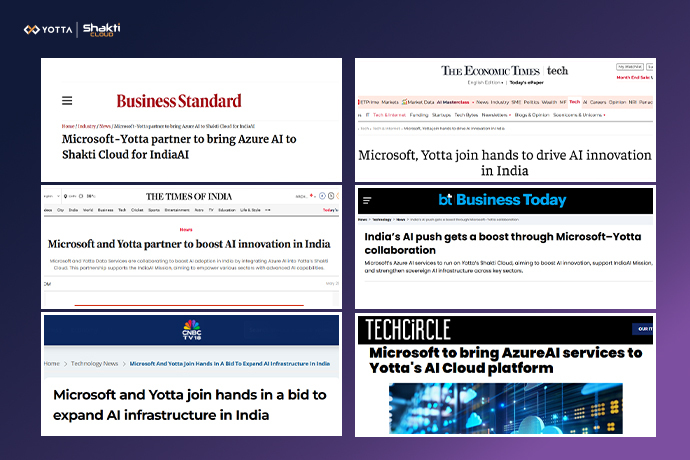
Our news was picked up by The Times of IndiaThe Economic TimesCNBC TV-fv18Business Standard, Business TodayTech Circle – and echoed across top-tier publications nationwide. For a tech story to cut through the noise like that, something has to click. This did.

Because this isn’t another cloud announcement.

This is a blueprint for India’s AI future.

Together with Microsoft, we’re building an AI environment that’s made in India, for India. Azure’s intelligence. Shakti’s muscles. The collaboration merges Microsoft’s advanced AI models, versatile apps, agents, and developer tools with Yotta’s sovereign, cost-efficient, globally benchmarked GPU infrastructure. An AI stack that speaks the language of India’s enterprises, startups, and public sector.

And it’s fast – ultra-low latency fast. Built for real-time inferencing and heavy-duty model training, right here on Indian soil. Fully sovereign, deeply trusted, and engineered to meet the unique scale and complexity of our country.

This partnership is a shot in the arm for the IndiaAI Mission – the national push to make India a global hub for AI innovation. It’s designed to support the dream of homegrown innovation – whether that’s a researcher at an IIT, a startup founder in Bengaluru, or a government agency building the next generation of digital citizen services.

At Yotta, we’ve always believed that infrastructure is a silent power. But every once in a while, it’s okay for that power to make some noise. The kind that makes headlines.

And this time, it did.

This is India’s AI decade. And we’re proud to help shape it – one GPU cycle, one breakthrough, one story at a time.

Catch the story behind the headlines – Read the press release