











Best Practices for Managing Resources in a Multi-Cloud Environment 

Multi-cloud architecture is no longer an emerging trend; it’s an established reality. Recent industry reports show that nearly 90% of enterprises have embraced a multi-cloud strategy to leverage the unique strengths of different providers and enhance resilience. However, this strategic move introduces significant operational hurdles. The top challenge cited by a majority of these organisations is managing cloud spend, with an estimated 30% of cloud expenditure being wasted on inefficient resources. This complexity creates a critical need for a disciplined, technical approach to resource management.

Without a robust framework, the promise of multi-cloud agility can be quickly undermined by fragmented visibility, inconsistent security, and runaway costs. Successfully managing a distributed infrastructure requires moving beyond ad-hoc efforts to a cohesive, technology-driven strategy.

Technical Best Practices for Multi-Cloud Management 

To truly harness the power of a multi-cloud or hybrid cloud environment, organisations must implement a set of core technical disciplines.

  • Establish Unified Governance with Infrastructure as Code (IaC): In a multi-cloud setup, manual configuration is a direct path to security gaps and inconsistencies. The best practice is to manage your infrastructure programmatically using IaC tools like Terraform. By defining your resources—from virtual machines to network security groups—in version-controlled code, you create a single source of truth. This allows you to enforce standardised security policies, manage configurations, and ensure compliance across all cloud platforms automatically.
  • Implement Comprehensive Observability, Not Just Monitoring: Basic monitoring of CPU and memory is no longer enough. True visibility across a distributed environment requires observability the ability to analyse metrics, logs, and traces in a unified platform. Implementing a “single-pane-of-glass” observability solution is critical. It allows your teams to correlate performance issues and security events across your on-premises data center and multiple cloud providers, drastically reducing Mean Time to Resolution (MTTR) and identifying root causes that would otherwise remain hidden in data silos.
  • Enforce Proactive FinOps and Cost Optimisation: To combat the estimated 30% of wasted cloud spend, organisations must adopt a proactive financial operations (FinOps) model. This involves more than just monitoring a monthly bill.
  • Automated Scheduling: Implement “start/stop” schedules for non-production environments to ensure you’re not paying for idle development and testing resources during off-hours.
  • Continuous Rightsizing: Use performance data from your observability platform to continuously rightsize virtual machines and storage volumes, ensuring you pay only for the capacity you need.
  • Leverage Spot Instances: For fault-tolerant or batch-processing workloads, strategically using spot or preemptible instances can reduce compute costs by up to 90% compared to on-demand pricing.

The Strategic Accelerator: Cloud Management Services 

While establishing a FinOps culture and an IaC pipeline in-house is the goal, the reality is that it requires a rare and expensive combination of multi-platform expertise. The complexity multiplies in a hybrid cloud model, where bridging the operational gap between on-premises and public cloud systems is a persistent challenge. This is where expert Cloud Management Services act as a strategic accelerator. 

Engaging a specialised provider gives you immediate access to the certified expertise and sophisticated toolsets required to implement these technical best practices effectively and at scale. At Yotta, our Cloud Management Services are designed to function as an extension of your team. We provide the unified platform and proactive governance needed to bring order to your multi-cloud estate, allowing you to focus on innovation while we ensure your infrastructure is secure, compliant, and cost-efficient. 

 A multi-cloud strategy without a technically sound management framework is an incomplete strategy. It invites risk and inefficiency that negate the very benefits you seek to achieve. By implementing these technical best practices, you can transform your multi-cloud environment from a source of complexity into a powerful engine for business growth.

Evaluating Cloud Security Measures: Key Considerations for Professionals

The rapid adoption of cloud infrastructure in India has unlocked immense business agility, but it has also introduced a new scale of security and financial risk. According to a recent IBM report, the average cost of a data breach in India has surged to an all-time high of ₹19.5 crore. Furthermore, with attacks exploiting cloud vulnerabilities increasing by 180%, traditional security strategies are no longer sufficient. For years, organisations relied on a defined perimeter—a digital “castle-and-moat”—but the distributed nature of the hybrid cloud has made that model obsolete. 

This new reality demands a fundamental shift in how professionals evaluate and implement cybersecurity. The focus must move from a perimeter-based defence to a more integrated strategy where security is a continuous, data-centric process. For any organisation operating in the cloud today, building a resilient security posture is not just an IT task; it is an urgent business imperative. 

The Shared Responsibility Misconception

A primary source of confusion in cloud security is the “Shared Responsibility Model.” While cloud providers secure the underlying infrastructure (the “cloud itself”), the customer is always responsible for securing what’s in the cloud—their data, applications, and user access. Misunderstanding this division of labour often leads to critical security gaps. A robust security evaluation, therefore, begins with a clear understanding of what your provider covers and, more importantly, what you are solely responsible for protecting. 

Key Pillars of a Modern Cloud Security Evaluation 

Evaluating a cloud environment requires a multi-faceted approach. Instead of focusing on a single perimeter, professionals must assess a series of interconnected domains to build a truly resilient security posture. 

  • Identity and Access Management (IAM): In the cloud, identity is the new perimeter. A rigorous IAM strategy is non-negotiable. This means moving towards a “Zero Trust” model, where no user or device is trusted by default. Your evaluation should scrutinise how principles of least-privilege access are enforced, whether multi-factor authentication (MFA) is standard, and how access policies are regularly reviewed and audited. 
  • Data-Centric Security and Encryption: With assets distributed across various locations, the data itself must be the final line of defence. A key consideration is the robustness of encryption protocols. Is sensitive data encrypted both at rest (in storage) and in transit (as it moves between services and users)? Evaluating this ensures that even if a system is compromised, the data stays unreadable and secure. 
  • Continuous Monitoring and Threat Detection: A “set-and-forget” security policy is a recipe for disaster. Effective cloud security relies on continuous, 24/7 monitoring to detect anomalies and potential threats in real-time. This involves analysing logs from various sources, identifying unusual user behaviour, and having an automated alert system that can flag suspicious activity before it escalates into a full-blown breach. 
  • Compliance and Governance Frameworks: Your cloud operations must align with industry-specific and regional regulatory requirements. A proper evaluation involves mapping your security controls directly to these standards (such as ISO 27001, PCI DSS, or the DPDP Act). This not only mitigates the risk of non-compliance penalties but also provides a structured framework for supporting security best practises. 

The Expert Advantage: The Role of Cloud Management Services 

Achieving this level of deep, continuous security evaluation is a significant challenge. It demands specialised skills, sophisticated tools, and constant vigilance—resources that many organisations cannot support in-house. This is where expert Cloud Management Services become indispensable. 

By partnering with a specialised provider, organisations gain access to a team of security experts and a suite of advanced tools designed for the complexities of modern IT. At Yotta, our Cloud Managed Services provide a unified, single-pane-of-glass view to manage and secure your entire infrastructure, which is especially critical in a fragmented hybrid cloud environment. We implement proactive security measures, manage compliance, and provide the 24/7 monitoring needed to turn your security posture from reactive to resilient. This allows your team to focus on innovation, confident that the underlying infrastructure is secure. 

Relying on legacy security tools for your cloud infrastructure is like putting a simple padlock on a digital vault. It creates a false sense of security while leaving you exposed to modern, sophisticated threats. It’s time to embrace a new framework for security one built for the borderless reality of the cloud.

Best Practices for Securing Your Hybrid Cloud Environment 

As organisations increasingly adopt hybrid cloud architectures – blending private, public, and on-premise infrastructures – the complexity of securing these environments has grown significantly. Gartner predicts that by 2027, 90% of organisations will embrace hybrid cloud strategies, highlighting the urgent need to scale hybrid infrastructures to support the growing demand for Gen AI deployment.  

While hybrid setups offer unmatched flexibility, scalability, and cost-efficiency, they also create a fragmented infrastructure landscape marked by inconsistent security tools, varying identity management systems, and uneven visibility across platforms. Public cloud services may offer integrated IAM and monitoring, but private data centers often require separate solutions – leading to gaps in enforcement and increased risk of misconfigurations. This broader threat surface is further amplified by the rise of AI-powered attacks and the limitations of siloed security tools. To address these challenges, IT leaders must implement a comprehensive strategy that integrates advanced technologies, zero trust principles, and continuous oversight to meet evolving security and compliance demands. 

Start with a Unified Security Framework 

The foundation of a secure hybrid cloud lies in a consistent security strategy that spans all environments. Security objectives should align closely with broader business goals, supported by comprehensive risk assessments that reflect the interconnected nature of modern infrastructure. Clear governance policies are essential – defining how data is classified, how access is managed, how networks are segmented, and how compliance is maintained across platforms. 

Equally important is the implementation of strong data governance practices. These should specify where different categories of data are stored and how they are protected as they move throughout the hybrid cloud. This approach reduces the risk of misconfigurations and ensures uniform data protection across the entire ecosystem. 

Zero Trust Architecture (ZTA) is Non-negotiable

Perimeter-based security will not suffice in a hybrid cloud model. Rather, companies must adopt Zero Trust Architecture, enforcing strict identity verification and least-privilege access for users seeking to access resources. Zero Trust principles operate on the belief that no user or application – whether internal or external to the network – should be trusted by default. 

Implementing Zero Trust involves deploying multi-factor authentication (MFA), strong Identity and Access Management (IAM), micro-segmentation, and continuous monitoring of user behavior. Tools such as Security Information and Event Management (SIEM) systems and endpoint detection and response (EDR) can help enforce ZTA policies. 

In addition, strong application security practices are critical. This includes regular vulnerability assessments, secure coding standards, and continuous testing to ensure applications running across the hybrid cloud are not vulnerable to exploitation. 

Encrypt Everything: In Transit and At Rest 

Encryption is one of the simplest yet most effective defenses against data breaches. All sensitive data—whether in transit between cloud services or at rest in storage—should be encrypted using modern cryptographic standards. Cloud-native services can simplify the management of encryption keys while ensuring regulatory compliance. 

Organisations must also secure backups and archives, ensuring they are encrypted and access is restricted. 

Unified Identity and Access Management (IAM) 

IAM is the gatekeeper of your cloud environment. A robust IAM system centralises user identities, governs access rights, and ensures that only authorised individuals can interact with specific cloud resources. Implement Role-Based Access Control (RBAC) and Attribute-Based Access Control (ABAC) to assign permissions based on job roles or attributes, thus minimizing the attack surface. 

To prevent privilege creep, organisations must adopt automated provisioning and de-provisioning, integrate IAM with HR systems, and conduct frequent access reviews and audits. 

Security Monitoring, Threat Detection, and Response 

Real-time visibility is essential to securing hybrid cloud environments. Organisations must invest in advanced monitoring solutions that can detect anomalies, trigger alerts, and respond to incidents across all layers of their hybrid architecture. This includes cloud-native tools as well as third-party platforms. 

Security Operations Centers (SOCs) should employ threat intelligence feeds and machine learning algorithms to proactively identify suspicious patterns and reduce mean time to detect (MTTD) and mean time to respond (MTTR). 

Strengthen Endpoint Security 

In hybrid cloud environments, endpoints such as user devices, VMs, and IoT assets become high-risk entry points for attackers. Securing these endpoints with EDR, NGAV, and device-level encryption is critical to prevent malware, ransomware, and lateral movement. Regular patching, hardening configurations, and disabling unused services further reduce vulnerabilities. Integrating endpoint telemetry with your SIEM or XDR platform ensures real-time visibility and faster incident response. For sensitive workloads, enforce strict posture checks using MDM or UEM tools. 

Yotta: Securing Hybrid Cloud Environments 

Yotta offers a “Hybrid and Multi-Cloud” approach, providing a single-window platform designed to simplify operations and significantly enhance security across private, public, hybrid, and multicloud infrastructures. This unified platform allows for seamless integration, improved performance, and centralised governance, empowering businesses to leverage the benefits of diverse cloud environments without the typical management complexities and security inconsistencies.     

Yotta adopts a security-by-design philosophy, embedding protection mechanisms into every stage of the cloud lifecycle – from design and deployment to daily operations and ongoing optimisation. This includes rigorous validation checks and alignment with industry best practices to ensure a consistent and robust security posture.  

A key differentiator is Yotta’s comprehensive cybersecurity suite, Suraksha, which offers multi-layered, end-to-end protection against cyber threats. Suraksha includes advanced Identity and Access Management (IAM), robust encryption for data in transit and at rest, real-time threat detection, and proactive incident response – designed to deliver holistic enterprise security. Yotta’s 24/7 Security Operations Centre (SOC), staffed by certified security professionals, provides continuous monitoring, threat hunting, and rapid incident remediation.  

Furthermore, Yotta’s Global Cloud Konnect solution offers secure, private, and direct connectivity to major hyperscale cloud providers – bypassing the public internet. This not only reduces exposure to potential threats but also enhances network performance and reduces latency, which is critical for data-intensive workloads spread across hybrid and multicloud deployments. 

Evaluating the Cost-Benefit Analysis of Migrating to Public Cloud Solutions for Enterprise Businesses

As enterprise businesses increasingly consider migrating to public cloud solutions, conducting a thorough cost-benefit analysis (CBA) becomes essential. This analysis helps IT leaders, finance managers, procurement officers, and cloud strategy teams make informed decisions that align with their organizational goals.

Evaluating the Costs of Public Cloud Migration for Enterprises

When evaluating the costs of migrating to the public cloud, enterprises must consider several factors:

1. Initial Setup Costs:

  • Infrastructure Configuration: Setting up the cloud infrastructure involves configuring virtual machines, storage, networking, and security measures. These costs can vary depending on the level of customization and the specific cloud services chosen.
  • Licensing and Subscription Fees: Enterprises may need to purchase licenses or subscribe to cloud services, which can add to the initial setup costs.

2. Data Transfer Costs:

  • Volume of Data: Moving large volumes of data to the cloud can incur significant charges. The amount of data being transferred directly impacts these costs.
  • Transfer Speed: Faster data transfer speeds can lead to higher costs, depending on the cloud service provider’s pricing model.

3. Service Provider Charges:

Different cloud service providers have varying pricing structures for data transfer, which can influence the overall cost. Application Refactoring Costs:

  • Redesign and Rewriting: Some applications may need to be redesigned or rewritten to function optimally in a cloud environment. This process, known as refactoring, can be a substantial part of the migration budget.
  • Compatibility Testing: Ensuring that applications are compatible with the new cloud environment may require extensive testing and adjustments.

4. Ongoing Operational Costs:

  • Cloud Service Fees: After migration, enterprises will face ongoing expenses such as cloud service fees, which can include costs for compute, storage, and networking resources.
  • Maintenance and Optimization: Regular maintenance and optimization efforts are necessary to ensure the cloud environment remains efficient and cost-effective.

5. Training and Support Costs:

  • Staff Training: Employees will need training to use new cloud technologies effectively. This can involve both initial training sessions and ongoing education.
  • Support Services: Ongoing support services will be necessary to maintain operations and address any issues that arise.

6. Potential Downtime:

  • Business Impact: There may be potential downtime during the migration process, which could impact business operations. Planning for and mitigating this downtime is crucial to minimizing disruptions.

The Benefits of Public Cloud Migration for Enterprises

The benefits of migrating to the public cloud can be substantial:

1. Scalability:

  • Resource Flexibility: Public cloud solutions offer the ability to scale resources up or down based on demand, ensuring optimal performance and cost-efficiency.
  • Elasticity: Enterprises can quickly adjust their resource allocation to meet changing business needs without significant delays.

2. Flexibility:

  • Wide Range of Services: Enterprises gain access to a wide range of cloud services and tools that can be tailored to specific business needs.
  • Customization: Cloud solutions can be customized to fit the unique requirements of different departments and projects.

3. Cost Savings:

  • Reduced Capital Expenditures: Migrating to the public cloud can reduce capital expenditures on physical infrastructure, such as servers and data centers.
  • Lower Operational Costs: Operational costs can be lower due to the pay-as-you-go pricing model of cloud services, which allows enterprises to pay only for the resources they use.

4. Enhanced Security:

  • Advanced Security Features: Public cloud providers offer advanced security features, such as encryption, identity and access management, and threat detection.
  • Compliance: Cloud providers often comply with industry standards and regulations, which can enhance data protection and ensure regulatory compliance.

5. Innovation:

  • Faster Deployment: The public cloud enables faster deployment of new applications and services, allowing businesses to stay competitive and respond quickly to market changes.
  • Access to Cutting-Edge Technologies: Enterprises can leverage the latest technologies, such as artificial intelligence, machine learning, and big data analytics, available through cloud services.

6. Improved Productivity:

  • Focus on Innovation: Cloud migration can lead to improved productivity by allowing IT teams to focus more on new projects and development rather than maintaining on-premises infrastructure.
  • Collaboration Tools: Cloud solutions often include collaboration tools that enhance teamwork and streamline workflows.

Conducting a Comprehensive Cost-Benefit Analysis

To conduct a comprehensive CBA, enterprises should follow a structured approach:

  • Define Goals and Objectives: Clearly outline the goals and objectives of cloud migration. This includes identifying the desired outcomes and how they align with the organization’s strategic goals.
  • Collect Detailed Information: Gather data on current IT costs, projected cloud costs, and potential benefits. This involves a thorough assessment of both tangible and intangible factors.
  • Compare Costs and Benefits: Analyze the costs and benefits over a defined period, considering both quantitative and qualitative factors. This comparison should include a detailed breakdown of all relevant expenses and anticipated advantages.
  • Assess Potential Risks: Evaluate risks associated with migration, such as data security and compliance issues. Identifying and mitigating these risks is crucial to ensure a smooth transition.
  • Provide Recommendations: Based on the analysis, recommend whether to proceed with the migration and outline necessary steps. This should include a clear action plan and any contingencies that need to be addressed.

Key Considerations for Enterprises in Their CBA

When conducting a CBA, enterprises should consider several key factors:

  • Total Cost of Ownership (TCO): Evaluate both direct and indirect costs associated with the migration and ongoing cloud operations.
  • Return on Investment (ROI): Calculate the expected ROI to determine the financial viability of migration. This involves comparing the projected benefits against the total costs.
  • Impact on Business Operations: Assess potential disruptions and long-term benefits to business operations. This includes evaluating how migration will affect day-to-day activities and overall business performance.
  • Choosing the Right Cloud Service Provider: Select a provider that meets the organization’s needs and offers reliable support. Consider factors such as service level agreements (SLAs), customer support, and the provider’s track record.
  • Compliance and Security: Ensure the chosen cloud solution complies with industry regulations and provides robust security measures. This is essential to protect sensitive data and maintain regulatory compliance.

Conclusion: Making Informed Cloud Decisions Through Rigorous CBA

Conducting a thorough cost-benefit analysis is crucial for enterprise businesses considering a migration to public cloud solutions. By carefully evaluating the costs, benefits, and potential risks, IT leaders, finance managers, procurement officers, and cloud strategy teams can make informed decisions that drive innovation and achieve strategic goals.

Once a Whisper, Now a Roar: India’s AI Is Taking Off
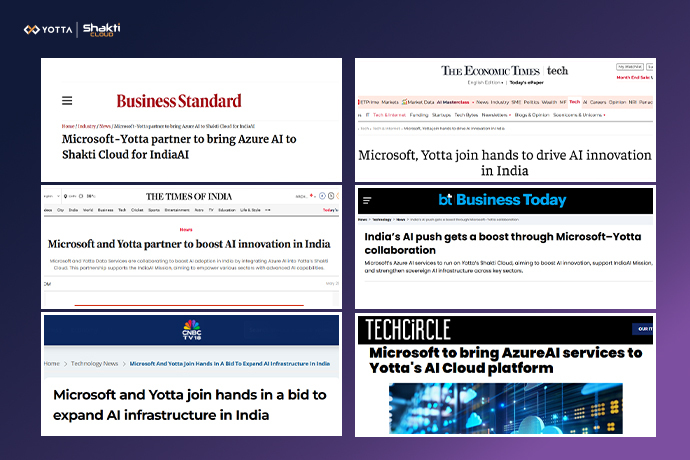
When we announced our partnership with Microsoft to power Shakti Cloud with Azure AI, we expected the industry to take note. What followed was far bigger.

Our news was picked up by The Times of IndiaThe Economic TimesCNBC TV-fv18Business Standard, Business TodayTech Circle – and echoed across top-tier publications nationwide. For a tech story to cut through the noise like that, something has to click. This did.

Because this isn’t another cloud announcement.

This is a blueprint for India’s AI future.

Together with Microsoft, we’re building an AI environment that’s made in India, for India. Azure’s intelligence. Shakti’s muscles. The collaboration merges Microsoft’s advanced AI models, versatile apps, agents, and developer tools with Yotta’s sovereign, cost-efficient, globally benchmarked GPU infrastructure. An AI stack that speaks the language of India’s enterprises, startups, and public sector.

And it’s fast – ultra-low latency fast. Built for real-time inferencing and heavy-duty model training, right here on Indian soil. Fully sovereign, deeply trusted, and engineered to meet the unique scale and complexity of our country.

This partnership is a shot in the arm for the IndiaAI Mission – the national push to make India a global hub for AI innovation. It’s designed to support the dream of homegrown innovation – whether that’s a researcher at an IIT, a startup founder in Bengaluru, or a government agency building the next generation of digital citizen services.

At Yotta, we’ve always believed that infrastructure is a silent power. But every once in a while, it’s okay for that power to make some noise. The kind that makes headlines.

And this time, it did.

This is India’s AI decade. And we’re proud to help shape it – one GPU cycle, one breakthrough, one story at a time.

Catch the story behind the headlines – Read the press release

The Role of Public Cloud in Enhancing Data Security and Compliance for Modern Organisations

Public cloud computing has fundamentally transformed how organisations manage their IT infrastructure. However, as businesses migrate to the cloud, concerns related to security, data sovereignty, and compliance remain high on the agenda. For instance, a recent survey by PwC found that 83% of businesses cited security as the biggest challenge when transitioning to the cloud, illustrating the magnitude of concern around data protection and governance in a cloud environment.

Real-world incidents underscore the critical importance of properly configuring cloud security to mitigate risks. A notable example is ICICI Bank, one of India’s largest private-sector banks, which experienced a data leak in 2020 due to misconfigured cloud storage settings. This breach exposed sensitive customer information and highlighted the vulnerabilities that can arise when cloud security protocols are not meticulously implemented. This case serves as a stark reminder that cloud security misconfigurations are a leading cause of data breaches, with 50% of all breaches in 2020 attributed to human error, such as misconfiguration. As a result, public cloud services have become synonymous with robust security, making them an ideal solution for modern organisations.

How Public Cloud Enhances Data Security

1. Multi-Layered Security Approach: Public cloud providers use a multi-layered security model to protect their infrastructure from both internal and external threats. This includes advanced firewalls, intrusion detection systems, and DDoS mitigation strategies. Yotta’s Enterprise Cloud offers these security features out-of-the-box, backed by continuous monitoring to detect and mitigate potential vulnerabilities. Organisations can focus on their core business functions while relying on Yotta’s robust security infrastructure to shield them from cyber threats.

2. Identity and Access Management (IAM): Identity and access management (IAM) tools are critical for maintaining strict control over who accesses sensitive data and systems. Yotta’s cloud platform includes advanced IAM capabilities that allow organisations to implement role-based access controls (RBAC), ensuring that only authorised users can access specific data or systems. This minimises the risk of unauthorised access, whether by malicious actors or internal employees.

3. Advanced Encryption and Data Protection: Public cloud platforms like Yotta’s Enterprise Cloud offer enterprise-grade encryption to protect data both in transit and at rest. This ensures that sensitive information, whether it’s customer data or proprietary business insights, is shielded from cyberattacks or unauthorised access. For example, Yotta’s cloud infrastructure ensures that all data is encrypted using the latest industry standards, ensuring compliance with even the most stringent security regulations.

Enhancing Compliance with Public Cloud Solutions

1. Meeting Regulatory Requirements: Compliance is a significant challenge for businesses that deal with sensitive information, particularly in industries like healthcare, finance, and government. Yotta’s Enterprise Cloud is designed to meet international compliance standards such as ISO 27001, PCI DSS, and SOC 2, ensuring that organisations using the platform can easily meet regulatory requirements. Yotta also provides tools for auditing, logging, and reporting, which are essential for demonstrating compliance during audits and inspections.

2. Data Sovereignty and Residency: Another significant challenge that organisations face is ensuring that their data is stored and processed in the right geographical locations, in compliance with data residency laws. Yotta’s public cloud services provide options for data localisation, ensuring that businesses can store their data within the country or region that aligns with local data protection regulations.

3. Automated Reporting and Auditing: Yotta’s cloud infrastructure includes built-in tools that help organisations maintain visibility into their cloud environment. With automated reporting and real-time monitoring, businesses can track data access, changes to sensitive data, and user activities. This functionality helps meet the compliance needs of highly regulated industries that require audit trails and transparency, such as finance and healthcare.

4. Business Continuity and Disaster Recovery: Cloud environments are inherently more resilient than on-premises infrastructure, but a well-designed cloud strategy must still include business continuity and disaster recovery (BC/DR) measures. Yotta’s Enterprise Cloud offers robust BC/DR options to ensure that businesses can quickly recover from outages, natural disasters, or other disruptions. This is critical for compliance with regulations that mandate data availability and continuity of operations.

5. Yotta Enterprise Cloud: A Game Changer in Security and Compliance Yotta’s Enterprise Cloud, hosted in the world’s 2nd largest Tier IV data center, Yotta NM1, delivers the highest level of reliability to organisations across industries. With an infrastructure uptime SLA of 99.99%, Yotta’s cloud services ensure that businesses can rely on continuous access to their data, applications, and services. Furthermore, Yotta’s self-service portal provides organisations with full control over their cloud environment, allowing them to easily manage, monitor, and scale their operations.

For businesses that require additional support, Yotta offers optional managed cloud services, with certified cloud professionals available 24×7 to assist with cloud management, troubleshooting, and optimisation. This makes Yotta’s Enterprise Cloud an ideal solution for organisations, without the overhead of managing cloud infrastructure themselves.

Conclusion

The public cloud is a powerful tool for modern organisations seeking to enhance data security and ensure compliance with ever-evolving regulations. By leveraging platforms like Yotta’s Enterprise Cloud, businesses can achieve high levels of security, operational efficiency, and regulatory compliance while scaling their operations to meet future demands.

Key Trends shaping cloud computing in 2025

Cloud computing market projections show an expected growth to $864 billion by 2025, with a remarkable 21.5% expansion rate. Gartner predicts that hybrid cloud adoption will reach 90% of organisations by 2027. The digital world continues to evolve through groundbreaking cloud trends that alter how businesses grow and scale. Edge computing combined with 5G now enables immediate data processing. AI integration enhances automation and creates individual-specific experiences. Data centre power usage will likely increase by 160% by 2030. This surge could generate 2.5 billion metric tonnes of carbon dioxide emissions, making eco-friendly cloud computing essential today.

This piece explores the key trends in cloud computing and looks at the most important factors shaping the industry in 2025.

1. Digital transformation: Digital transformation—the integration of digital technologies into all areas of business—is driving rapid cloud adoption. Organizations leveraging cloud computing achieve up to 3x faster time to market and 30% higher operational efficiency. A McKinsey study highlights that companies embracing digital transformation can increase profits by 20%

2. AI driven cloud optimisation: A study initiated by the global SaaS company Ciena has revealed that a majority of IT engineers believe that the use of AI would improve network operational efficiency by 40%. AI-driven cloud optimization is set to significantly shape the cloud market in 2025 by enhancing efficiency, security, and cost management. Here are some of the ways it will define the market. Enhanced security measures driven by AI can analyse vast amounts of data to detect anomalies and potential threats, allowing quicker responses to security incidents and reducing the risk of data breaches. AI also facilitates predictive analytics by analysing historical data to forecast future trends and demands.

Additionally, AI continuously monitors and analyses cloud usage to identify cost-saving opportunities, such as shutting down unused resources or optimizing workloads for cheaper alternatives. Finally, AI improves performance by distributing workloads across the most efficient resources, ensuring high performance and reliability.

3. Efficiency with Edge Computing: 75% of respondents from a survey (initiated by Lumen technologies and Intel) of business leaders, agreed that 5ms Latency is a necessity for applications for edge computing initiatives. And in the modern tech sphere, companies need edge computing to process data in real-time. This speed allows instant data analysis and decision-making, especially when you have healthcare and manufacturing requirements. Edge cloud infrastructure consistently keeps latency under 5ms, while on-premises edge solutions deliver sub-millisecond responses for critical applications.

4. Emerging Technologies: 5G, IoT, and Internet Adoption: The global IoT market is expected to reach $1.1 trillion by 2026, fueled by rapid 5G expansion. 5G networks process data 100 times faster than 4G, enabling ultra-low latency applications and significantly enhancing real-time cloud interactions. Cloud-based remote work solutions have led to a 60% rise in productivity among hybrid workforce models, further solidifying the importance of seamless connectivity in modern business operations.

5. Seamless Deployment with Serverless Computing: Serverless computing is set to revolutionize cloud technology by enhancing developer productivity with advanced tools for debugging, local development, and monitoring, thus accelerating innovation and reducing time-to-market for new applications. It will support seamless deployment across multiple cloud platforms, enabling businesses to optimize performance, reduce costs, and avoid vendor lock-in by leveraging the unique strengths of different providers.

Serverless computing will simplify the deployment and management of AI and machine learning models, facilitating real-time data processing and analytics for actionable business insights. With the proliferation of IoT and edge computing, serverless solutions will become essential for handling massive data volumes, enhancing the scalability and efficiency of cloud-based data analytics crucial for applications like smart cities, autonomous vehicles, and industrial automation.

6. Hybrid & Multi-cloud Strategies: Multi-cloud and hybrid cloud strategies are set to redefine cloud technology, offering businesses greater flexibility, resilience, and efficiency. The adoption of hybrid and multi-cloud environments will continue to grow, with 89% of organizations leveraging multiple cloud providers to avoid vendor lock-in and optimize performance according to Statista.

AI-driven hybrid cloud management will play a crucial role, as AI tools analyse data flows and optimize workload distribution across public and private environments, enhancing cost-effectiveness and performance. Additionally, AI-driven threat detection systems will improve security by identifying vulnerabilities before they escalate.

Edge computing integration will be another key strategy. By processing data closer to the source (e.g., IoT devices) and integrating results with private and public clouds, hybrid cloud enables seamless edge-to-cloud integration.

The adoption of zero trust security models, which demand continuous verification of user identities and device integrity, will protect data across diverse environments. This approach will ensure robust security in hybrid and multi-cloud setups.

Finally, a study by Gartner says that increased cloud spending will be a significant trend. Worldwide end-user spending on public cloud services is forecast to total $723.4 billion in 2025, up from $595.7 billion in 2024.

7. Advancements in Cloud Security: Security remains a top priority in cloud computing, with AI-driven cybersecurity reducing threat detection times by 60%. Secure Access Service Edge (SASE) frameworks are improving security postures, reducing breaches by 45%. As cyber threats continue to evolve, businesses are investing in next-generation security solutions to protect sensitive data and maintain compliance.

8. Introduction of Quantum Computing via the Cloud: Cloud providers are now offering quantum computing services, enabling businesses to solve complex problems beyond the reach of classical computers. Quantum computing can process calculations exponentially faster than traditional systems, making breakthroughs in fields such as cryptography, pharmaceuticals, and logistics. IBM, Google, and AWS have launched quantum computing services, allowing researchers and enterprises to experiment with quantum algorithms via the cloud. As quantum technology matures, businesses will gain access to unparalleled computational power that could revolutionize AI training, financial modeling, and material sciences.

9. Growth of Industry-Specific Cloud Solutions: Tailored cloud services are emerging to meet the unique needs of various industries, ensuring compliance and efficiency. In healthcare, cloud solutions provide secure patient data management and AI-powered diagnostics. Financial institutions benefit from high-performance cloud computing for fraud detection and algorithmic trading. Manufacturing leverages cloud-based IoT integrations to optimize supply chain operations. By aligning cloud services with industry requirements, providers enable businesses to operate with enhanced security, scalability, and regulatory compliance.

10. Sustainability and green cloud computing: Sustainability and green cloud computing are at the forefront of the cloud market, driven by increasing environmental concerns and regulatory pressures. Cloud providers are now offering more transparency into their sustainability practices, with metrics like Power Usage Effectiveness (PUE) and Water Usage Effectiveness (WUE) becoming standard. These metrics allow businesses to make informed decisions based on the environmental impact of their cloud services

Governments and regulatory bodies are imposing stricter sustainability requirements on cloud providers. This includes mandatory reporting on energy usage and carbon emissions, as well as incentives for adopting green technologies. Compliance with regulations like the General Data Protection Regulation (GDPR) ensures that cloud providers operate within legal and ethical boundaries

Environmental sustainability stands as a vital concern in cloud operations. Moving business applications to the cloud can cut energy consumption and carbon emissions by 30% to 90%, depending on the organization size. Small businesses with 100 users see the highest benefits, reducing emissions by up to 90%. Medium-sized companies with 1,000 users achieve 30-60% reductions based on studies from E+E Leader platform.

Data center operators use several strategies to boost sustainability. These include using renewable energy sources for power generation, creating facility designs that improve airflow, setting up water cooling systems to manage heat, and using AI-driven energy management solutions. These measures collectively contribute to more sustainable and efficient cloud operations.

Conclusion:

In conclusion, these trends collectively highlight a dynamic and innovative future for cloud technology, where businesses can leverage advanced tools and strategies to drive growth, efficiency, and sustainability. As we move forward, staying abreast of these developments will be crucial for organizations looking to harness the full potential of cloud technology. Finally, AIOps is revolutionizing IT operations by automating and enhancing monitoring, troubleshooting, and optimization processes, leading to higher performance and reduced operational costs.

Why IBM P-Series Leads The Way: The Case For Power Systems

IBM Power Systems are high-performance server platforms built for enterprises that demand exceptional reliability and scalability. These systems are powered by IBM’s proprietary POWER processors, that can handle data-intensive workloads such as AI, analytics, and hybrid cloud deployments. The design philosophy centers around performance, availability, and future-readiness, making Power Systems ideal for industries like finance, healthcare, and retail.

Features of IBM Power Systems

  • Advanced RAS Capabilities: IBM Power Systems provide advanced Reliability, Availability, and Serviceability (RAS) features that detect and correct errors. Their predictive failure analysis and dynamic processor sparing minimise downtime by addressing potential issues.
  • High Performance: IBM Power Systems use POWER processors, built on a multi-core architecture, to deliver processing power for data-intensive tasks. This infrastructure supports advanced parallel processing, enabling rapid execution of AI models, big data analytics, and complex simulations with minimal latency.
  • AI and Hybrid Cloud-Ready: IBM Power Systems integrate native AI accelerators such as GPUs and specialised deep learning hardware, optimised for large-scale machine learning workloads.

Future-Ready Architecture

IBM Power Systems offer a future-ready architecture designed to integrate with hybrid cloud strategies. The platform’s open architecture supports multi-cloud environments, enabling businesses to deploy and manage workloads across private and public clouds with ease.

IBM’s support for both cloud-native and legacy applications ensures that businesses can transition smoothly to the cloud without disrupting their existing infrastructure. The flexibility of IBM Power Systems provides the foundation for a hybrid environment that can evolve as business needs change.

AI and ML Integration for Modern Enterprises

IBM Power Systems provide exceptional capabilities for businesses seeking to integrate Artificial Intelligence (AI) and Machine Learning (ML) into their operations. Powered by advanced AI accelerators and the powerful POWER processors, IBM’s infrastructure is designed to run complex AI and ML workloads with ease.

By utilising the high-performance capabilities of IBM Power Systems, businesses can utilise AI and ML models to drive innovation, automate processes, and enhance data-driven decision-making. Whether it’s predictive analytics, natural language processing, or real-time insights, IBM Power Systems offer a platform that empowers enterprises to scale their AI and ML initiatives.

Finding the Perfect Fit: Feature Analysis of Top Server Platforms

  • Performance and Reliability: IBM Power Systems are widely recognised for their exceptional performance and reliability. According to ITIC’s 2020 Global Server Hardware and Server OS Reliability Survey, IBM Power Systems achieved the highest reliability ratings among all server platforms. On the other hand, Oracle SPARC servers are specifically optimised for Oracle databases and applications.
  • Total Cost of Ownership (TCO): Although it seems that IBM Power Systems may have higher upfront costs than x86-based systems, but studies show they offer a lower TCO. Factors such as higher per-core performance, reduced software licensing expenses, and lower power and cooling requirements contribute to cost efficiency. Meanwhile, Dell EMC’s x86-based PowerEdge servers are designed to minimise initial infrastructure and licensing costs.
  • Scalability and Flexibility: IBM Power Systems support diverse workloads, including cloud, AI, big data analytics, and open-source applications. Oracle SPARC servers deliver seamless integration with Oracle’s software ecosystem, enabling optimal performance for Oracle applications. While Dell EMC servers provide scalability and hybrid-cloud capabilities, their flexibility is generally tailored toward virtualisation and cloud-native workloads.
  • Security: IBM Power Systems have a strong track record in security, with no reported breaches in PowerVM at the time of ITIC’s reliability survey. Oracle SPARC servers, known for their advanced encryption capabilities, ensure data security at rest, in transit, and in storage without performance degradation. Features like Silicon Secured Memory provide continuous intrusion detection.

Why Choose IBM Power Systems?

  • Performance and Scalability: IBM Power Systems deliver unmatched performance for mission-critical workloads such as SAP HANA, AI, and analytics.
  • Flexibility: With support for AIX, Linux, and IBM i, Power Systems accommodate diverse workloads, ensuring adaptability to evolving business needs.
  • Resilience: Industry-leading RAS features and disaster recovery capabilities ensure uptime and data protection.
  • Cost Efficiency: Despite higher initial costs, Power Systems offer lower TCO, reducing software and operational expenses over time.

Innovate and Scale With Yotta Power Cloud – Powered By IBM

Yotta Power Cloud seamlessly integrates your private cloud and on-premises infrastructure with a unified public cloud environment, creating a flexible, cost-efficient, and robust IT ecosystem. Powered by IBM, Yotta Power Cloud is tailored to meet diverse industry demands, providing scalable and high-performance solutions.

  • Enterprise Resource Planning (ERP): Yotta Power Cloud streamlines the deployment of ERP systems, enabling organisations to efficiently manage extensive databases and perform resource-intensive tasks critical to business operations.
  • Big Data and Analytics: Yotta Power Cloud allows businesses to handle complex analytics workloads, transforming large datasets into actionable insights.
  • Database Management: For enterprises requiring reliable and high-performing database solutions, Yotta Power Cloud provides the stability needed to manage and protect vast amounts of data.
  • Virtualisation: Using IBM PowerVM, Yotta Power Cloud supports running multiple virtual servers on a single machine. This enhances resource utilisation, reduces infrastructure costs, and simplifies system management.
  • AI and Machine Learning: The advanced capabilities of Yotta Power Cloud make it a powerful platform for running AI and machine learning models. Organisations can accelerate development, deployment, and scaling of AI-driven solutions.
  • Healthcare Applications: Yotta Power Cloud is well-suited for powering healthcare systems, including electronic health records and medical imaging, ensuring enhanced patient care.
  • Telecommunications: The platform efficiently handles the complex requirements of telecom operations, such as network management and billing systems, while managing the high data traffic demands of communication networks.

Success Stories

  • Transforming a Nationalised Bank’s IT Landscape: A leading nationalised bank sought Yotta Power Cloud to modernise its IT infrastructure and overcome scalability and security challenges. By migrating its core banking systems, the bank achieved high availability, enhanced data protection, and improved regulatory compliance. This upgrade enabled the bank to reduce latency, lower operational costs, and enhance customer satisfaction.
  • Driving Innovation in Chemical Manufacturing: A prominent chemical manufacturing company adopted Yotta Power Cloud to transition its complex IT environment to a cloud-first approach. This shift enabled real-time monitoring of operations, streamlined supply chain management, and improved compliance tracking. The company benefitted from reduced IT costs, enhanced system reliability, and support for sustainability goals.

Accelerating Business Success with Yotta Power Cloud

IBM Power Systems stand out due to their exceptional performance, scalability, and future-ready architecture, making them a top choice for enterprises seeking to modernise IT infrastructure. For businesses aiming to stay ahead of the curve, Yotta Power Cloud, powered by IBM, is a comprehensive, future-proof solution that accelerates growth, optimises IT resources, and ensures long-term success.

Unified Cloud and Networking Management: Streamlining Operations Across Multiple Cloud Platforms and on-premises Environments

Businesses are increasingly adopting multi-cloud strategies to leverage the strengths of different cloud providers and enhance operational flexibility. Unified cloud and networking management is becoming a critical capability for organisations to streamline operations across multiple cloud platforms and on-premises environments.

Connectivity is key to achieving this, but establishing multiple connections to different cloud platforms results in high costs, complex management, and a lack of visibility and control. Imagine a solution that bridges the gap between your infrastructure and cloud platforms, while eliminating the hassles of complex connections and high costs. Unified cloud management is becoming a critical capability for organisations to streamline operations across multiple cloud platforms and on-premises environments.

Unified cloud management involves integrating and overseeing various cloud services—public, private, and hybrid—alongside on-premises systems through a single management interface. This approach helps organisations simplify operations, enhance visibility, and boost efficiency by providing a clear view and control over all IT resources. By consolidating management tasks, organisations can reduce complexity, streamline workflows, and ensure consistent policies across their different environments.

  1. Flexibility and Avoidance of Vendor Lock-In: One of the key benefits of multi-cloud solutions is the flexibility to choose the best cloud services for specific needs. By avoiding vendor lock-in, organisations can select different cloud providers based on their strengths—such as superior machine learning capabilities, robust security features, or cost-effective storage solutions. This flexibility enables businesses to optimise their cloud strategy and adapt to changing requirements.
  2. Enhanced Risk Management: Relying on a single cloud provider can expose organisations to risks such as service outages or data breaches. Multi-cloud strategies mitigate these risks by distributing workloads across multiple providers. This diversification reduces the impact of a single point of failure and enhances overall system resilience.
  3. Access to Best-of-Breed Services: Different cloud providers offer specialised services that may be superior in specific areas. For instance, one provider might excel in data analytics, while another is known for its cutting-edge AI tools. Multi-cloud computing allows organisations to leverage the strengths of various providers, ensuring they have access to the most advanced and suitable services for their needs.

Understanding Yotta’s Unified Cloud Management:

Yotta’s Unified cloud management platform along with Global Cloud Konnect solution, integrated with DE-CIX DirectCLOUD, facilitates easy connectivity between  major global cloud providers such as Microsoft Azure, AWS, Google Cloud,  Oracle Cloud, Office 365. Seamless connectivity across different cloud platforms ensures smooth data flow, reduces transfer costs, and minimises latency, enabling businesses to optimise their multi-cloud strategy without being hindered by network complexity or performance issues.

Features of Yotta Global Cloud Konnect

  • Direct Connectivity for Colocated Clients: Businesses colocated at Yotta can establish direct connectivity using Cross Connect to connect their infrastructure to DE-CIX nodes. This setup provides straightforward access to a variety of cloud services via Global Cloud Konnect.
  • Convenient Access from Various Connectivity Locations: Organisations with on-premises infrastructure can also take advantage of Global Cloud Konnect by linking their systems to the closest Yotta connectivity site, ensuring smooth integration and enhanced connectivity options.
  1. Simplified Operations: Managing multiple cloud platforms and on-premises systems individually can lead to increased complexity and operational overhead. Unified cloud management simplifies these operations by providing a single pane of glass for monitoring, controlling, and managing IT resources. This centralisation reduces the need for disparate management tools and interfaces, streamlining administrative tasks and minimising the risk of errors. For example, instead of navigating through various cloud provider dashboards and on-premises management systems, IT teams can access a unified platform that integrates all their resources. This streamlined approach allows for more efficient task execution, from provisioning and configuring resources to monitoring performance and managing incidents.
  2. Enhanced Visibility and Control: One of the primary advantages of unified cloud management is the enhanced visibility it provides into the entire IT landscape. By consolidating data from multiple cloud platforms and on-premises systems, organisations gain a comprehensive view of their infrastructure. This visibility enables better decision-making and more effective management of resources. It typically includes dashboards and reporting tools that aggregate data from various sources. IT teams can monitor key performance indicators (KPIs), track resource utilisation, and analyses trends across their entire environment. This holistic view facilitates proactive management, allowing teams to identify and address potential issues before they impact operations.
  3. Consistent Policy Enforcement: In a multi-cloud and hybrid environment, ensuring consistent policy enforcement can be challenging. It helps address this issue by providing tools to implement and enforce policies across all environments. Organisations can define security protocols, compliance requirements, and operational standards centrally, ensuring that all resources adhere to the same guidelines. For instance, security policies such as access controls, encryption standards, and vulnerability management can be applied uniformly across cloud and on-premises resources. This consistency helps reduce the risk of security breaches and compliance violations, ensuring that the organisation’s IT environment remains secure and compliant.
  4. Cost Optimisation: With resources spread across multiple cloud providers and on-premises systems, tracking and optimising expenditures can be complex. Unified management tools provide insights into resource usage and spending patterns, helping organisations identify opportunities for cost savings. By analysing data from various sources, IT teams can optimise resource allocation, eliminate waste, and negotiate better pricing with cloud providers. Additionally, unified management solutions often include budgeting and forecasting features, allowing organisations to plan and manage their IT budgets more effectively.
  5. Improved Security and Compliance: Security and compliance are top priorities for organisations operating in multi-cloud and hybrid environments. Unified cloud management enhances security by providing centralised control over access, monitoring, and threat detection. This approach ensures that security measures are consistently applied across all resources, reducing vulnerabilities, and improving overall protection. Unified management platforms often include advanced security features such as real-time threat monitoring, automated incident response, and compliance reporting. These tools help organisations detect and respond to security incidents more quickly, ensuring that their IT environment remains secure and compliant with relevant regulations.
  6. Seamless Integration and Interoperability: A key challenge in multi-cloud and hybrid environments is ensuring that different systems and platforms work together seamlessly. Unified cloud management solutions facilitate integration and interoperability by providing connectors and APIs that bridge disparate systems. For example, a unified management platform can integrate with various cloud providers’ APIs, allowing for smooth data transfer and application interoperability. This integration simplifies workflows, enables more efficient resource management, and enhances the overall user experience.

Conclusion:

To optimise performance in a multi-cloud environment, seamless integration of your infrastructure and cloud services is important. Yotta Global Cloud Konnect simplifies this by providing a reliable connection to leading global cloud providers, ensuring your data takes the fastest route and reducing latency. This solution also eases the workload on your IT teams by consolidating connections, streamlining operations, and enhancing service delivery to customers-all while lowering costs.

How Yotta Power Cloud Revolutionises Hybrid Cloud Computing

The demand for robust, flexible, and secure IT infrastructures has never been higher. Traditional data centers and legacy systems are increasingly being replaced by cloud solutions that offer scalability, cost-efficiency, and enhanced performance. Yotta Power Cloud, a cutting-edge platform built in collaboration with IBM Power, is designed to revolutionise the way enterprises manage their critical workloads and emerging technologies.

Yotta Power Cloud elevates hybrid cloud computing by unifying private cloud and on-premises infrastructure with a seamless public cloud environment. This combination creates a flexible and powerful IT ecosystem capable of meeting the growing demands of modern businesses.

The Power of IBM Power in Yotta Power Cloud

One of the key reasons Yotta Power Cloud stands out is its collaboration with IBM Power. IBM has long been recognised as a leader in the enterprise IT space, known for its innovative and reliable solutions. The IBM Power Systems—specifically the IBM P-Series—are trusted by businesses around the globe for their unmatched performance, reliability, and security. Yotta Power Cloud delivers a robust, enterprise-ready cloud infrastructure designed to handle both today’s and tomorrow’s workloads.

Here are some of the core benefits that Yotta Power Cloud provides:

  • Unmatched Reliability and Uptime: IBM Power is built to provide industry-leading server reliability and uptime. According to IBM, 93% of IBM Power customers report up to 6x better system reliability and availability. For enterprises that rely on mission-critical applications, this level of reliability is a game-changer. Downtime is costly, and with Yotta’s proven infrastructure, businesses can ensure their operations remain seamless and uninterrupted, even during high-demand periods.
  • Enterprise-Ready Cloud Integration: IBM Power easily integrates with private or hybrid cloud environments, making it an ideal choice for businesses seeking to build or migrate their workloads to the cloud. Whether you are looking to extend your on-premise infrastructure to the cloud or fully transition to a hybrid cloud model, Yotta Power Cloud offers a flexible and customizable solution that adapts to your specific needs. This integration ensures a smooth and efficient transition with minimal disruption to business operations.
  • Cutting-Edge Technology: Yotta Power Cloud leverages the most advanced processor technologies available today. Powered by IBM Power’s state-of-the-art I/O subsystem technology, including next-gen NVIDIA NVLink, PCIe Gen4, and OpenCAPI, this cloud platform is built for high-performance computing. These technologies allow for faster data processing, more efficient workload management, and seamless scaling, making it an ideal solution for businesses looking to harness the full potential of AI, machine learning, and other data-intensive applications.
  • Proactive Security and Threat Detection: In an age where cybersecurity threats are increasingly sophisticated, businesses need infrastructure that can not only detect attacks but also respond quickly. Yotta Power Cloud provides enhanced security features that protect your enterprise from breaches. One standout feature is its ability to detect and thwart attacks immediately or within just 10 minutes of a breach. This proactive approach gives businesses a much larger response window to mitigate potential damage, protecting both sensitive data and business continuity.

Supporting Emerging Technologies

As businesses increasingly turn to technologies like AI, machine learning, and big data analytics to stay competitive, they need a cloud infrastructure that can keep pace. Yotta Power Cloud is designed to support these emerging technologies by providing the high-performance computing power, advanced storage, and security needed to handle massive data volumes and complex workloads.

The platform’s ability to seamlessly integrate with AI and ML frameworks ensures that businesses can easily deploy, scale, and manage their AI models in the cloud. Whether you are training deep learning models or running big data analytics, Yotta Power Cloud provides the resources and flexibility needed to accelerate innovation and unlock valuable insights from your data.

Conclusion

The future of cloud computing is hybrid, and Yotta Power Cloud is at the forefront of this revolution. By combining the best of IBM Power’s cutting-edge technology with the flexibility and scalability of hybrid cloud computing, Yotta Power Cloud offers a solution that is not only powerful but also future-proof. With unparalleled reliability, proactive security, and support for emerging technologies, Yotta Power Cloud is the perfect platform for businesses looking to take advantage of the latest IBM p-series machines, without the hefty CapEx associated with it,

For enterprises that want to embrace the future of cloud computing, Yotta Power Cloud offers a flexible, cost-efficient, and secure solution that will accelerate their digital transformation journey.